Introduction
Modern software engineering organizations operate in environments where shipping code is only the starting point. Once an application reaches production, engineering teams must keep services reliable, secure, observable, and cost-efficient while continuing to release new features at a steady pace. As microservices, cloud-native infrastructure, and distributed architectures grow more complex, informal habits and ad-hoc operational fixes stop working.
Without a clear view of their operational strengths and weaknesses, teams often spend time reacting to outages, debating which tooling investments matter most, or duplicating infrastructure work across squads. Engineering leaders need a structured, repeatable way to evaluate how well their organization runs production systems and decide what to improve next. Whether a team is preparing a critical service for launch through a production readiness assessment or re-evaluating multi-team delivery workflows, objective baselines make improvement measurable.
OpsRoadmaps is an engineering operations assessment and improvement platform built specifically to help software organizations close this gap. Rather than treating operational improvement as guesswork, the platform guides teams through a clear lifecycle: discovering operational challenges, evaluating capabilities through structured self-assessments, interpreting explainable maturity scores, prioritizing high-risk gaps, building dependency-aware improvement roadmaps, and tracking progress over time.
Understanding the Strengths and Gaps in DevOps Practices
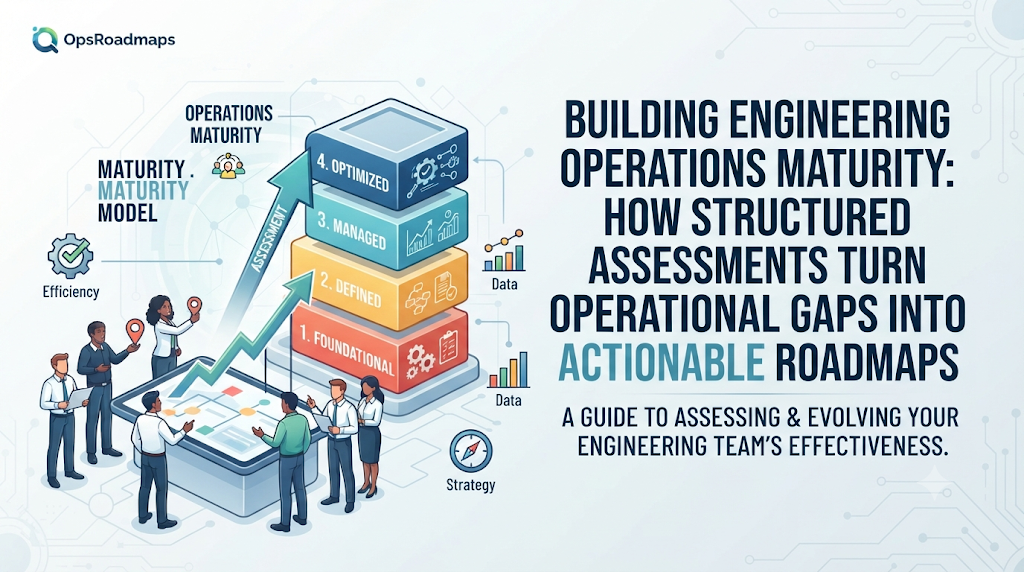
Engineering operations maturity describes how consistently, reliably, and safely an organization builds, deploys, operates, and evolves its production software systems. High operational maturity is never defined by how many cloud services, automation scripts, or monitoring dashboards a company owns. An organization can purchase modern deployment tools and still struggle with fragile releases, unclear on-call ownership, and recurring production outages.
True operational maturity emerges from the alignment of people, processes, architecture, and tooling across the entire software lifecycle. It spans how code moves through continuous integration and delivery pipelines, how infrastructure is provisioned and governed, how reliability targets are defined, how security controls are enforced, and how teams respond when systems fail. When these practices operate in silos, improvements in one area often create bottlenecks in another—such as faster deployment pipelines pushing unverified changes into poorly monitored clusters.
Conducting a structured DevOps maturity assessment helps organizations move beyond subjective opinions and examine their actual day-to-day capabilities. By answering targeted, capability-based questions across delivery, infrastructure, reliability, and operations, teams uncover hidden gaps that daily firefighting often obscures. Transparent, versioned scoring criteria ensure that evaluations remain consistent across teams and repeatable over time, allowing engineering leaders to measure real progress rather than relying on assumptions.
Preparing Kubernetes Workloads for Real-World Operations
Running containerized applications in Kubernetes introduces powerful orchestration capabilities, but it also shifts significant operational responsibility onto engineering teams. Default cluster configurations and basic deployment manifests are rarely sufficient for production traffic, hardware failures, or security threats. Teams must verify that every workload can handle traffic spikes, node disruptions, rolling updates, and credential rotation without degrading user experience.
Before promoting services to live traffic, platform and infrastructure teams rely on a Kubernetes production readiness checklist to systematically review critical operational controls. Walking through standardized verification criteria ensures that foundational safeguards are not overlooked under release pressure:
- Compute and Scheduling Controls: Configure explicit CPU and memory requests and limits to prevent noisy-neighbor resource starvation, and pair them with Pod Disruption Budgets and topology spread constraints so workloads survive node maintenance and availability zone failures.
- Health Probes and Lifecycle Hooks: Define accurate startup, liveness, and readiness probes alongside graceful termination (
preStop) hooks so Kubernetes routes traffic only to healthy containers and drains active connections cleanly during rollouts. - Access Control and Network Isolation: Enforce least-privilege Role-Based Access Control (RBAC), disable unnecessary service account token automations, and apply default-deny NetworkPolicies to restrict lateral traffic between namespaces.
- Secrets Management and Configuration: Store sensitive credentials in external secret managers or encrypted secret stores rather than plaintext manifests or environment variables hardcoded in container images.
- Autoscaling and Capacity Planning: Configure Horizontal Pod Autoscalers (HPA) based on meaningful application metrics and validate cluster autoscaling behavior against realistic load profiles.
- Backup, Recovery, and Upgrade Readiness: Test persistent volume snapshots, etcd backup procedures, and API deprecation compatibility before scheduling cluster version upgrades.
While a structured checklist prevents common configuration oversights, it serves as a baseline verification gate rather than a substitute for load testing, chaos engineering, or workload-specific architecture reviews.
Planning the Introduction of an Internal Developer Platform
As engineering organizations scale, asking every product team to master Kubernetes manifests, Terraform modules, CI/CD pipelines, and cloud security policies creates heavy cognitive load. Developers spend valuable product-building hours troubleshooting infrastructure boilerplate, while platform and operations teams drown in repetitive support tickets. Platform engineering addresses this friction by treating internal infrastructure and delivery workflows as a cohesive product for developers.
Rather than purchasing a portal tool and expecting immediate adoption, successful platform teams follow a platform engineering adoption roadmap grounded in real developer pain points. Treating internal platforms as internal products requires intentional phasing and clear operational ownership:
- Discover Developer Friction: Interview application teams and analyze support tickets to identify the top bottlenecks slowing down service creation, environment provisioning, and production deployments.
- Design Golden Paths: Build paved-road templates and self-service workflows that cover standard deployment, observability, and security requirements out of the box without blocking teams that need custom configurations.
- Establish Platform Governance and Interfaces: Define clean APIs, Infrastructure as Code modules, and automated policy guardrails so self-service remains safe, compliant, and auditable.
- Pilot, Measure, and Iterate: Onboard a small group of early-adopter teams, track metrics such as lead time to first deployment and reduction in infrastructure tickets, and refine workflows based on user feedback.
When platform adoption is guided by measurable outcomes and structured capability milestones, internal platforms reduce operational variance while giving developers faster, safer paths to production.
Building Reliable Service Operations Step by Step
Reliability is a core product feature, yet many organizations treat it informally until major outages erode customer trust. Site Reliability Engineering (SRE) brings software engineering discipline to operations by balancing feature velocity with system stability through shared, quantitative targets. Instead of aiming for impossible perfection, SRE aligns development and operations teams around measurable reliability expectations.
Organizations transitioning from reactive operations to structured reliability practices benefit from a phased SRE adoption roadmap that introduces core concepts progressively:
- Define Service Level Indicators (SLIs) and Objectives (SLOs): Measure user-facing reliability signals—such as request latency, error rates, and availability—and establish realistic SLO targets that reflect actual customer expectations.
- Govern Releases with Error Budgets: Calculate the allowable failure margin derived from each SLO, using error budget consumption to guide decisions on whether to prioritize new features or reliability hardening.
- Identify and Automate Toil: Track repetitive, manual operational tasks that scale linearly with service growth, and dedicate engineering capacity to eliminating toil through reliable automation.
- Clarify Service Ownership and On-Call Health: Establish clear escalation paths, sustainable on-call rotations, and blameless post-incident learning practices so teams continuously strengthen system resilience.
Introducing SRE practices incrementally ensures that reliability targets remain practical, directly tied to user experience, and sustainable for engineering teams.
Improving How Engineering Teams Handle Production Incidents
Even well-architected distributed systems experience unexpected failures caused by traffic surges, third-party outages, or subtle code regressions. What separates resilient organizations from fragile ones is how quickly and calmly their teams detect issues, coordinate response, restore service, and prevent recurrence. Unstructured incident response leads to duplicated debugging efforts, delayed stakeholder updates, and repeated outages from unaddressed root causes.
Evaluating response workflows against an incident management maturity model helps engineering leaders pinpoint where coordination breaks down under pressure. Mature incident operations strengthen every phase of the failure lifecycle:
| Incident Phase | Core Operational Capabilities | Key Maturity Indicators |
| Detection and Triage | Automated alerting tied to SLO impact, clear severity definitions, and accurate alert routing | Low alert noise, fast acknowledgment, consistent severity classification |
| Command and Coordination | Designated Incident Commander, clear technical lead roles, and dedicated communication channels | Single source of truth during outages, minimal duplicate investigation |
| Communication and Escalation | Predefined internal and external status update cadences and documented escalation matrices | Timely stakeholder updates, rapid engagement of subject-matter experts |
| Post-Incident Learning | Blameless post-incident reviews, contributing factor analysis, and tracked corrective actions | High completion rate of preventive action items, shared organizational learning |
By systematically addressing gaps in severity definitions, role clarity, and follow-through on preventive tasks, teams reduce mean time to recovery (MTTR) and build operational confidence.
Integrating Security into the Software Delivery Process
When security reviews happen exclusively at the end of a release cycle, they become bottlenecks that delay deployments or force teams to accept unmitigated risks. DevSecOps shifts security checks earlier into everyday engineering workflows so vulnerabilities and misconfigurations are detected while code and infrastructure are still being written. Effective security integration makes secure practices the default path rather than an external hurdle.
A structured DevSecOps implementation roadmap helps security and engineering teams embed automated controls without overwhelming developers with false positives:
- Source Code and Dependency Hygiene: Integrate static application security testing (SAST), secret scanning in pre-commit hooks and repositories, and software composition analysis (SCA) to catch vulnerable third-party libraries early.
- Infrastructure as Code and Container Hardening: Scan Terraform, Helm, and Kubernetes manifests for insecure configurations, verify container base images for known vulnerabilities, and sign build artifacts to protect supply chain integrity.
- CI/CD Pipeline and Runtime Controls: Enforce least-privilege pipeline permissions, automate policy-as-code gates before production promotion, and maintain runtime access controls and audit logging.
- Risk-Based Vulnerability Management: Prioritize remediation based on exploitability, asset exposure, and business criticality rather than treating every low-severity scanner warning equally.
Tools alone never establish a mature security posture; lasting progress comes from shared accountability, clear remediation workflows, and continuous verification across delivery pipelines.
Developing Better Visibility into Distributed Systems
As monolithic applications give way to microservices, serverless functions, and managed cloud databases, understanding why a system is misbehaving becomes far harder. Traditional monitoring tells teams when a known threshold has been crossed—such as high CPU usage or elevated HTTP 500 errors—but often fails to explain novel failure modes across complex service dependencies. Observability extends monitoring by ensuring systems emit rich telemetry that lets engineers ask new questions about internal system state without shipping new code.
Assessing telemetry practices with an observability maturity model allows teams to evaluate whether their instrumentation actually supports fast root-cause investigation. Effective observability brings together standardized telemetry signals and disciplined alert design:
- Correlated Telemetry Pillars: Combine structured logs, high-resolution metrics, and end-to-end distributed traces using consistent service, environment, and trace identifiers so engineers can pivot seamlessly from a spike in latency to the exact failing downstream call.
- Instrumentation Standards: Adopt vendor-neutral telemetry standards such as OpenTelemetry across services to avoid fragmented SDKs and inconsistent metric naming.
- Actionable Alert Quality: Tie paging alerts to user-impacting symptoms rather than low-level infrastructure fluctuations, ensuring every alert links to a relevant dashboard or troubleshooting runbook.
- Dependency and Performance Mapping: Maintain clear visibility into upstream and downstream service dependencies, database query performance, and queue backlogs to isolate bottlenecks rapidly during incidents.
When observability is treated as a core engineering capability rather than an afterthought, teams spend less time guessing during outages and more time resolving underlying bottlenecks.
Making Cloud Spending More Efficient and Predictable
Cloud infrastructure makes it effortless to spin up compute, storage, and managed data services, which can quickly lead to runaway spending when utilization goes unmonitored. However, aggressive cost-cutting without operational context can strip away necessary redundancy, starve workloads of memory, and trigger production outages. FinOps bridges engineering, finance, and leadership so teams make informed trade-offs between cost, performance, and reliability.
Executing a disciplined cloud cost optimization roadmap enables organizations to eliminate waste while protecting service availability:
- Cost Allocation and Tagging Hygiene: Enforce consistent resource tagging and namespace labeling so cloud spend is accurately mapped to teams, products, and environments.
- Utilization Analysis and Rightsizing: Compare provisioned CPU, memory, and storage capacity against historical usage patterns to downsize over-provisioned instances safely without encroaching on peak headroom.
- Idle Resource and Storage Lifecycle Management: Identify unattached storage volumes, orphaned load balancers, stale snapshots, and non-production clusters running outside working hours, applying automated lifecycle policies.
- Commitment Planning and Unit Economics: Align reserved instances or savings plans with predictable baseline workloads, and track cloud cost per customer transaction or active user to connect spending with business growth.
By embedding cost visibility into engineering workflows and pairing rightsizing with reliability guardrails, organizations achieve sustainable cloud efficiency without sacrificing resilience.
Diagnosing Containers That Repeatedly Restart
Few Kubernetes errors interrupt deployments as visibly as CrashLoopBackOff. Rather than representing a single specific error, CrashLoopBackOff is a Kubernetes pod status indicating that a container inside the pod repeatedly starts, exits with a failure code, and is restarted by the kubelet with an exponentially increasing delay (up to five minutes between attempts). Common triggers include application exceptions on startup, missing environment variables or secrets, invalid command arguments, failing liveness probes, permission errors, out-of-memory (OOMKilled) terminations, or unreachable upstream dependencies.
Effective Kubernetes CrashLoopBackOff troubleshooting follows a systematic diagnostic sequence to pinpoint the exact exit reason before modifying manifests:
Bash
# 1. Check pod status, restart counts, and readiness across the target namespace
kubectl get pods -n <namespace>

# 2. Inspect pod events, container exit codes, termination reasons, and probe configurations
kubectl describe pod <pod-name> -n <namespace>

# 3. View current container logs for application startup errors
kubectl logs <pod-name> -n <namespace>

# 4. Retrieve logs from the previous terminated container instance
kubectl logs <pod-name> --previous -n <namespace>

# 5. Review recent namespace-level cluster events chronologically
kubectl get events -n <namespace> --sort-by=.metadata.creationTimestamp
(Note: Adjust <namespace> and <pod-name> to match your environment, and add -c <container-name> when inspecting multi-container pods.)
Start with kubectl describe pod to examine the Last State section: an exit code of 137 paired with OOMKilled points to memory exhaustion, while exit code 1 or 2 typically indicates an application crash or configuration syntax error. Use kubectl logs --previous to capture the exact stack trace emitted right before the container died, as current logs may be empty if the container crashes immediately. Finally, review kubectl get events to spot failed volume mounts, missing ConfigMaps or Secrets, or aggressive liveness probes killing slow-starting applications. Always fix the underlying configuration, dependency, or memory leak rather than blindly raising resource limits or deleting pods.
Connecting Assessments with Actionable Improvement Plans
Identifying operational weaknesses is only valuable when those insights translate into concrete engineering work. Many organizations run periodic maturity surveys or architecture reviews only to let the findings sit in static spreadsheets because teams lack clear priorities, dependency sequencing, or practical implementation guidance. Without a structured path from diagnosis to execution, teams either attempt too many changes at once or tackle low-impact tasks while critical production risks remain exposed.
An effective improvement workflow follows a clear progression:
- Establish a Repeatable Baseline: Evaluate current engineering practices using consistent, transparent criteria so every team shares a common definition of operational capability.
- Interpret Explainable Scores: Examine why specific capabilities scored low, distinguishing missing foundational controls from advanced optimizations.
- Prioritize by Operational Risk: Rank identified gaps according to their potential impact on production availability, security exposure, and delivery bottlenecks.
- Sequence Dependencies and Ownership: Map which foundational practices must be built first—such as telemetry standards before advanced alerting—and assign clear team ownership with measurable milestones.
- Reassess and Track Progress: Re-evaluate capabilities after completing roadmap milestones to verify that operational improvements actually stuck.
OpsRoadmaps is designed around this exact connection between structured evaluation and practical execution, pairing deterministic, explainable maturity scoring with source-backed recommendations and dependency-aware improvement plans.
How OpsRoadmaps Supports Engineering Teams
OpsRoadmaps brings operational assessments and practical engineering resources together in a single platform tailored for software delivery and operations teams. Across 42 engineering operations disciplines spanning nine domains—including DevOps, GitOps, DevSecOps, Site Reliability Engineering, observability engineering, incident management, cloud operations, platform engineering, FinOps, MLOps, and LLMOps—the platform helps organizations evaluate practices systematically and plan targeted improvements.
Engineering teams can interact with the platform across two complementary layers:
- Structured Operational Assessments: Teams can begin immediately with a free, account-free operational health scan to get a rapid snapshot of their current operational posture. Signed-in users can access deeper production readiness and reliability assessments powered by published, versioned scoring rules. Because the scoring methodology is transparent and deterministic, teams understand exactly how their maturity scores are calculated and can repeat evaluations consistently over time.
- Technical Knowledge Library and Implementation Resources: Alongside assessments, OpsRoadmaps provides practical technical resources built for daily engineering execution. These include structured engineering improvement roadmaps, operational checklists, architecture blueprints, reusable templates, weighted technology decision guides (such as comparing Terraform versus OpenTofu, ECS versus EKS, or Datadog versus Grafana), and hands-on troubleshooting runbooks covering issues like Kubernetes
CrashLoopBackOff, node failures, Kafka consumer lag, PostgreSQL performance bottlenecks, and AWS infrastructure incidents.
It is important to recognize the role of self-assessments accurately: self-reported maturity evaluations provide structured internal clarity and repeatable benchmarks for engineering teams, but they are not independent external audits, compliance certifications, or guarantees of production readiness. Instead, they give teams the visibility and practical blueprints needed to strengthen systems deliberately.
Frequently Asked Questions
What does engineering operations maturity mean? Engineering operations maturity measures how consistently, safely, and reliably an organization delivers, monitors, secures, and maintains production software. Rather than counting how many tools a team uses, maturity reflects repeatable practices across deployment automation, reliability targets, incident response, observability, security controls, and cost governance.
Why should engineering teams evaluate production readiness? Evaluating production readiness before launch uncovers missing operational safeguards—such as unconfigured health probes, weak access controls, absent backups, or blind spots in alerting. Systematic reviews reduce the likelihood of preventable outages during traffic spikes, deployments, or infrastructure failures and clarify operational ownership across teams.
How can organizations identify gaps in their DevOps practices? Organizations identify DevOps gaps by evaluating capabilities across the full software lifecycle using structured, consistent assessment questions rather than informal opinions. Examining delivery pipelines, Infrastructure as Code, testing, security, and operational feedback loops reveals where bottlenecks or manual handoffs slow down safe software delivery.
What should teams review before deploying Kubernetes workloads? Before running Kubernetes workloads in production, teams should verify CPU and memory requests and limits, startup, liveness, and readiness probes, Pod Disruption Budgets, RBAC permissions, NetworkPolicies, external secrets management, autoscaling rules, centralized logging and metrics, and tested backup and recovery procedures.
How does platform engineering improve developer workflows? Platform engineering reduces developer cognitive load by providing self-service infrastructure, reusable templates, and paved-road deployment workflows through an internal developer platform. Standardized golden paths embed security, observability, and compliance defaults automatically, allowing product engineers to ship services faster without managing raw infrastructure boilerplate.
What is the role of SRE in production reliability? Site Reliability Engineering applies software engineering principles to operations by defining measurable Service Level Indicators (SLIs) and Service Level Objectives (SLOs). SRE teams use error budgets to balance feature velocity against system stability, automate repetitive operational toil, and lead blameless post-incident learning.
Why should security be integrated into software delivery? Integrating security throughout the software delivery lifecycle catches vulnerabilities, leaked secrets, and insecure infrastructure configurations early when they are fastest and cheapest to fix. Automated scanning in code repositories, CI/CD pipelines, and container registries prevents late-stage release bottlenecks and reduces production security exposure.
How can observability help teams investigate production issues? Observability enables engineers to understand internal system behavior using correlated metrics, structured logs, and distributed traces. During production incidents, rich telemetry helps teams trace failures across microservice dependencies, isolate root causes quickly, and verify fixes without guessing or deploying emergency debug code.
What are common reasons Kubernetes containers repeatedly restart? Kubernetes containers repeatedly restart—entering a CrashLoopBackOff state—due to application startup exceptions, missing environment variables or secrets, invalid startup commands, out-of-memory (OOMKilled) terminations, failing liveness probes, permission errors, or unreachable database and network dependencies. Inspecting pod events and previous container logs pinpoints the exact cause.
How can engineering teams turn assessment results into improvement plans? Teams turn assessment results into actionable plans by reviewing explainable capability scores, ranking gaps by operational risk, and sequencing foundational dependencies first. Assigning clear owners, setting measurable milestones, pairing tasks with practical checklists or runbooks, and reassessing periodically ensures steady, verifiable progress.
Making Engineering Improvements Measurable
Engineering operations maturity is never a one-time milestone; as architectures, team structures, and traffic demands evolve, operational practices must evolve alongside them. Organizations that rely on ad-hoc fixes or tool-driven checklists eventually hit scaling bottlenecks, whereas teams that combine structured capability assessments with prioritized, dependency-aware roadmaps build lasting operational resilience.
By establishing clear baselines, addressing high-risk gaps systematically, and backing daily operations with proven checklists and runbooks, engineering leaders turn operational improvement into a measurable, continuous discipline. To evaluate your organization’s current practices and explore practical implementation resources, start with an operational health scan or browse the engineering roadmaps and troubleshooting guides available on OpsRoadmaps.