
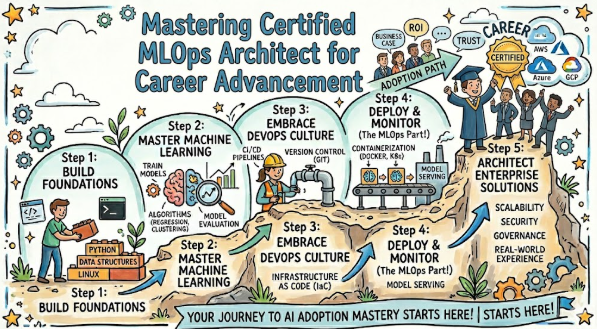
The landscape of modern engineering is shifting rapidly toward automated, scalable, and intelligent systems. As platforms grow in complexity, the gap between data science experimentation and production-ready machine learning has become a critical bottleneck for enterprises. The Certified MLOps Architect program is designed to bridge this gap, providing professionals with the framework to design, deploy, and manage robust ML pipelines at scale. Whether you are transitioning from traditional DevOps or looking to specialize in data-centric operations, this guide will help you understand how to aiopsschool certification programs can serve as a catalyst for your professional growth.
What is the Certified MLOps Architect?
The Certified MLOps Architect represents a specialized validation of an engineer’s ability to orchestrate machine learning lifecycles within complex production environments. Unlike theoretical data science programs, this certification focuses entirely on the operational side: continuous integration, continuous deployment, monitoring, and automated retraining of models. It exists because the industry has moved past the stage of “ML models in notebooks” toward “ML as a core service.” It aligns directly with the needs of modern organizations to keep models reliable, scalable, and secure while maintaining high-velocity deployment cycles.
Who Should Pursue Certified MLOps Architect?
This certification is designed for software engineers, DevOps practitioners, and Site Reliability Engineers who are tasked with operationalizing machine learning models. It is equally relevant for data engineers who want to understand the infrastructure side of their data products and for cloud architects building ML-specific platforms. Whether you are in the initial stages of your career or a seasoned lead looking to formalize your expertise in the ML domain, this path offers a clear roadmap. It is highly applicable for professionals working in both global tech hubs and the evolving Indian enterprise landscape, where digital transformation is driving a massive demand for standardized ML operations.
Why Certified MLOps Architect is Valuable Today
In an era where infrastructure and automation have become the backbone of business value, the Certified MLOps Architect designation proves that you can handle the unique challenges of machine learning, such as data drift, model decay, and pipeline reproducibility. As more companies adopt AI, the demand for experts who can manage the “plumbing” of intelligence is skyrocketing. This certification keeps professionals relevant by focusing on architectural principles that outlast specific vendor tools. It provides a significant return on your career investment by positioning you as a bridge between data teams and infrastructure teams, a role that is increasingly essential in mature engineering organizations.
Certified MLOps Architect Certification Overview
The program is delivered via Certified MLOps Architect and hosted on Aiopsschool. It follows a rigorous assessment approach that evaluates both your technical knowledge and your ability to design systems that solve real-world problems. The certification is structured to ensure that candidates possess the practical acumen required for enterprise deployments. Ownership of this credential signals to potential employers that you have moved beyond basic tutorials and have engaged with the complexities of production-grade ML infrastructure, making you a candidate capable of handling high-stakes operational environments.
Certified MLOps Architect Certification Tracks & Levels
The certification framework is tiered to accommodate different levels of expertise and career goals. The foundation level focuses on core concepts and basic pipeline orchestration, ensuring a solid grasp of the MLOps lifecycle. The professional level deepens the focus on scalability, security, and complex model lifecycle management, suitable for those who are actively managing production systems. Advanced levels are reserved for those designing enterprise-wide AI strategies and cross-functional ML platforms. These tracks allow professionals to align their certification journey with their specific role, whether that be in infrastructure, security, or data strategy.
Complete Certified MLOps Architect Certification Table
| Track | Level | Who it’s for | Prerequisites | Skills Covered | Recommended Order |
| Foundation | Beginner | Software Engineers | Basic Python & Linux | ML Basics & Pipelines | First |
| Professional | Intermediate | DevOps/SRE/Data Eng | 1+ Year Experience | CI/CD for ML & Scalability | Second |
| Advanced | Expert | Architects/Leads | 3+ Years Experience | ML Governance & Strategy | Third |
Detailed Guide for Each Certified MLOps Architect Certification
Certified MLOps Architect – Foundation Level
What it is
This certification validates a foundational understanding of the ML lifecycle, including data ingestion, version control, and basic model deployment. It establishes the baseline knowledge required to function within an ML-enabled team.
Who should take it
Aspiring ML engineers, junior DevOps engineers, and students who have a strong grasp of software engineering fundamentals but limited exposure to machine learning operations.
Skills you’ll gain
- Understanding of ML lifecycle stages.
- Basic version control for datasets and models.
- Introductory pipeline automation.
- Monitoring fundamentals for models.
Real-world projects you should be able to do
- Building a basic model training pipeline from scratch.
- Implementing a manual deployment process for a single model.
- Setting up simple alerts for model performance degradation.
Preparation plan
- 7–14 days: Focus on theoretical foundations of ML and versioning concepts.
- 30 days: Engage in hands-on labs for environment setup and basic script automation.
- 60 days: Review case studies and practice implementing end-to-end small-scale workflows.
Common mistakes
Focusing too much on the data science side rather than the operational lifecycle. Neglecting to learn containerization basics which are essential for MLOps.
Best next certification after this
- Same-track: Certified MLOps Architect – Professional.
- Cross-track: Certified DataOps Engineer.
- Leadership: Certified Cloud Solutions Architect.
Choose Your Learning Path
DevOps Path
The DevOps path focuses on the automation of the underlying infrastructure that supports machine learning. It covers the integration of traditional CI/CD tools with model-specific deployment requirements. Professionals learn how to containerize models and manage the lifecycle of microservices that expose those models. This ensures that machine learning is treated with the same engineering rigor as traditional software applications.
DevSecOps Path
The DevSecOps path emphasizes securing the ML pipeline, from the data source to the deployed model. It covers topics like model poisoning prevention, data privacy compliance, and secure access to training environments. It is ideal for engineers who need to ensure that their ML-enabled systems are not only operational but also resilient against malicious attacks. This path is vital for enterprise applications dealing with sensitive data.
SRE Path
The SRE path is centered on the reliability and scalability of ML systems. It focuses on setting Service Level Objectives (SLOs) for model serving and implementing automated recovery mechanisms for model failures. Candidates learn how to manage model latency and throughput, ensuring that the AI components of a system provide consistent value to the end-user. It bridges the gap between infrastructure uptime and model performance.
AIOps Path
The AIOps path focuses on using machine learning to improve IT operations. It covers the implementation of models to detect anomalies in infrastructure logs, automate incident response, and optimize resource allocation. It is highly relevant for SREs and Platform Engineers who want to move beyond manual monitoring and leverage AI to manage their vast system landscapes effectively.
MLOps Path
The MLOps path is the core journey for those specializing in the end-to-end lifecycle of machine learning. It covers everything from feature stores and automated experimentation to model serving and retraining loops. This path produces engineers who can effectively manage the continuous flow of data and code, ensuring that ML models remain accurate and valuable over long periods of time.
DataOps Path
The DataOps path focuses on the data pipeline side of machine learning. It covers data quality, data lineage, and the automated orchestration of large-scale data workflows. It is essential for engineers who need to ensure that the input data for machine learning models is clean, reliable, and accessible. It focuses on the velocity and quality of data delivery to training environments.
FinOps Path
The FinOps path explores the cost-efficiency of running machine learning models at scale. It covers the optimization of compute resources for training and inference, helping organizations understand the trade-offs between model performance and cloud infrastructure costs. It is perfect for those who want to align their technical architecture with business financial objectives.
Role → Recommended Certified MLOps Architect Certifications
| Role | Recommended Certifications |
| DevOps Engineer | Certified MLOps Architect – Foundation & Professional |
| SRE | Certified MLOps Architect – Professional |
| Platform Engineer | Certified MLOps Architect – Professional & Advanced |
| Cloud Engineer | Certified MLOps Architect – Foundation |
| Security Engineer | Certified MLOps Architect – Professional |
| Data Engineer | Certified MLOps Architect – Foundation & DataOps |
| FinOps Practitioner | Certified MLOps Architect – Professional |
| Engineering Manager | Certified MLOps Architect – Advanced |
Next Certifications to Take After Certified MLOps Architect
Same Track Progression
Once you have mastered the professional level, the logical next step is the Advanced Certified MLOps Architect. This involves moving into the domain of platform design, where you define the standards, governance, and infrastructure templates for entire organizations rather than just individual models. It is about architectural influence.
Cross-Track Expansion
Consider moving into Certified DataOps or Certified FinOps. Because MLOps sits at the intersection of data and cost, understanding how data flows from source to training (DataOps) or how to optimize the costs associated with GPU compute (FinOps) will make you a versatile and highly sought-after engineering lead.
Leadership & Management Track
For those transitioning into management, certifications in technical leadership or specialized management tracks are recommended. These focus on building teams, defining strategy, and managing the cultural shifts necessary for successful AI adoption, moving your focus from “how to build” to “what to build and why.”
Training & Certification Support Providers for Certified MLOps Architect
DevOpsSchool
This provider is a cornerstone for engineering education, offering extensive resources and structured learning paths for those looking to master operational disciplines.
Cotocus
Focusing on emerging technology stacks, this organization provides deep-dive practical training that is essential for staying current with industry standards.
Scmgalaxy
Known for a rigorous approach to source control and pipeline management, this provider is excellent for engineers focusing on the fundamentals of automation.
BestDevOps
Specializing in the intersection of development and operations, this provider offers targeted certifications that emphasize practical, hands-on enterprise skill sets.
devsecopsschool
This entity focuses on the integration of security into the development lifecycle, providing critical training for professionals tasked with building resilient systems.
sreschool
Dedicated to site reliability, this provider offers specialized programs that teach the principles of system uptime, scalability, and automated incident management.
aiopsschool
As the primary host for the MLOps architect program, this school provides specialized training focused on the application of intelligence to operational systems.
dataopsschool
Focusing on the data pipeline and engineering side of the house, this school is essential for those specializing in the data lifecycle and management.
finopsschool
This provider focuses on the financial aspect of cloud engineering, teaching professionals how to manage and optimize costs in complex infrastructure environments.
Frequently Asked Questions (General)
- What is the typical difficulty level of the certification?
The difficulty is aligned with industry-standard professional certifications, requiring both conceptual knowledge and practical application, but it is achievable with hands-on practice. - How much time is required to prepare for a certification?
Most professionals find that between four to eight weeks of consistent study, combined with practical experimentation, is sufficient to prepare for a professional-level exam. - Are there any prerequisites I should have before starting?
While you can start with a foundation level, a basic understanding of Linux, Python, and cloud infrastructure concepts is highly recommended to succeed. - What is the ROI of getting certified in this field?
The ROI is significant, as it provides a standardized way to demonstrate your skills to employers, often leading to better job opportunities and higher compensation. - Should I start with the foundation or jump straight to professional?
It is highly recommended to start with the foundation unless you have extensive real-world experience, as it ensures there are no gaps in your fundamental understanding. - How do these certifications help in my career growth?
They provide a structured learning path that keeps you up-to-date with industry standards, helping you move into more senior architecture and lead roles. - Is it better to get a broad set of certifications or focus on one track?
Focusing on a deep track initially is usually more beneficial for your career, followed by broadening your skills once you have established expertise in your primary domain. - How often are these certifications updated?
The curriculum is reviewed periodically to reflect changes in industry practices and new technological advancements, ensuring the material remains relevant. - Are these certifications recognized globally?
Yes, the certifications are designed to align with universal industry standards and are recognized by organizations looking for verified technical competency. - Can I use these certifications to transition into a new role?
Absolutely, many professionals use these certifications to signal their readiness when pivoting from a traditional DevOps role into a specialized MLOps or SRE role. - Do I need access to specific cloud providers to get certified?
The concepts taught are generally provider-agnostic, though having access to a major cloud platform will significantly enhance your ability to complete the hands-on projects. - Is there a community or support system for candidates?
Yes, most certification paths provide access to forums, community groups, and expert mentorship to assist you throughout your learning journey.
FAQs on Certified MLOps Architect
- What specifically does the Certified MLOps Architect validate?
It validates your ability to design and manage the operational infrastructure required to sustain machine learning models in a high-velocity production environment. - How does this certification differ from a data science certification?
This certification focuses on the engineering and infrastructure side—CI/CD, monitoring, and scaling—rather than the math or model training algorithms. - Can this help me automate model retraining?
Yes, a core component of the certification is learning how to design the pipelines that trigger and execute automated model retraining based on performance data. - Is it necessary to know machine learning theory for this?
You need to understand the ML lifecycle, but you do not need to be a research scientist; you need to understand how models behave in production. - How does this certification address model drift?
The curriculum covers the implementation of observability and monitoring frameworks designed specifically to detect data and model drift early. - Are there hands-on labs involved in the certification process?
Yes, the program emphasizes practical application, ensuring you can configure pipelines, manage container orchestration, and handle deployment strategies in real scenarios. - Does this cover security for ML models?
Yes, it covers secure handling of training data, model registry security, and protecting the model serving infrastructure from common vulnerabilities. - Will this help me move into an AI Architect role?
It provides the essential infrastructure and operational knowledge that is a prerequisite for any architect involved in designing enterprise AI platforms.
Final Thoughts: Is Certified MLOps Architect Worth It?
If you are an engineer who enjoys the intersection of data and infrastructure, this certification is a highly practical investment. It moves you away from the chaotic, manual way many organizations handle machine learning and toward an engineering-led, systematic approach. It is not a magic badge that replaces experience, but it is an excellent tool to structure your learning and prove your capability to handle production environments. My advice as a mentor: treat the certification as a goal to force yourself to get hands-on with the tools, not just to pass an exam. If you do the work, you will find yourself in a much stronger position to lead the next generation of AI-enabled systems.

