
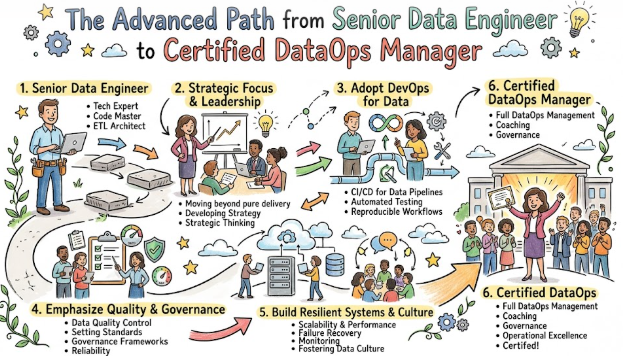
Introduction
Modern enterprise engineering environments are drowning in massive pipelines of data that require rapid, secure, and reliable deployment. If you are a DevOps engineer, site reliability engineer, or engineering manager, you already know that traditional software delivery workflows do not seamlessly translate to complex data architectures. This comprehensive industry guide is designed to help professionals navigate data delivery pipelines through the CDOM – Certified DataOps Manager program. Offered through the specialized training platform DataOpsSchool, this certification bridges the gap between agile development principles and operational data infrastructure. By establishing structured orchestration across infrastructure, code, and data flows, this framework allows technical leaders to make better career decisions while building highly resilient, scalable enterprise data systems.
What is the CDOM – Certified DataOps Manager?
The CDOM – Certified DataOps Manager is a professional designation designed to validate an engineer’s ability to orchestrate, automate, and manage enterprise data pipelines. Rather than focusing purely on theoretical data management concepts, this certification emphasizes real-world, production-focused learning. It addresses the friction that occurs when data engineers, data scientists, and infrastructure operations teams work in silos.
The framework aligns directly with modern cloud-native engineering workflows, emphasizing continuous integration, continuous delivery, and rigorous automated testing for data assets. Enterprise organizations rely on this methodology to replace fragile, manual data operations with repeatable, automated infrastructure patterns. By mastering these principles, professionals learn to manage data pipelines with the same level of discipline, monitoring, and quality control found in mature platform engineering ecosystems.
Who Should Pursue CDOM – Certified DataOps Manager?
This certification program benefits a wide spectrum of technology professionals looking to scale their infrastructure and data capabilities. Infrastructure engineers, site reliability engineers, and cloud architects will find immense value in learning how to apply operational rigor to data architectures. Similarly, data engineers, database administrators, and business intelligence professionals can utilize this track to transition into scalable, automated infrastructure management.
The curriculum serves a dual audience, providing clear learning tracks for both hands-on technical professionals and high-level strategic leaders. Early-career engineers gain the foundational skills needed to manage complex pipelines, while senior engineers and platform managers learn to architect governance frameworks. From a geographic perspective, this program holds deep relevance for both the rapidly expanding digital infrastructure market in India and the global enterprise landscape where distributed data sovereignty is critical.
Why CDOM – Certified DataOps Manager is Valuable and Beyond
The global demand for reliable data infrastructure is growing exponentially, making data pipeline orchestration a critical requirement for enterprise compliance and efficiency. Traditional tool-specific certifications often lose relevance when an organization migrates from one cloud vendor or data warehouse to another. This management certification focuses heavily on foundational principles, lifecycle architectures, and strategic governance that remain relevant regardless of underlying tool shifts.
By shifting the focus from individual tool sets to comprehensive pipeline orchestration, professionals protect their careers against technology obsolescence. The return on time and career investment is highly visible, as organizations actively seek leaders who can reduce pipeline downtime and accelerate data delivery. Embracing this methodology ensures that engineering teams can deliver high-quality, trusted data at the rapid pace modern business units require.
CDOM – Certified DataOps Manager Certification Overview
The structured educational program is delivered directly via the CDOM – Certified DataOps Manager and hosted natively on the DataOpsSchool. The framework evaluates a candidate’s practical readiness through objective assessments, case study analyses, and scenario-based management challenges. Ownership of the curriculum rests with industry practitioners who continually update the material to mirror actual production incidents and enterprise shifts.
The structure is broken down into modular segments that cover pipeline automation, quality assurance frameworks, infrastructure management, and team governance. Candidates must demonstrate a comprehensive understanding of how data flows safely from raw ingestion sources to end-user consumption points. This structured approach ensures that certified professionals possess the practical capability to oversee multi-cloud data operations effectively.
CDOM – Certified DataOps Manager Certification Tracks & Levels
The certification framework is organized into three distinct operational tiers to reflect a professional’s growing enterprise responsibilities. The foundation tier establishes core literacy, ensuring that candidates understand version control, basic automation pipelines, and automated data validation concepts. The professional tier shifts toward active architecture management, covering complex multi-cloud configurations, advanced orchestration engines, and deep monitoring systems.
The advanced management tier targets technical leaders who must design overarching data strategies, handle compliance structures, and optimize infrastructure budgets. Specialized sub-tracks allow systems engineers to focus heavily on continuous operations, while management candidates focus on governance, metrics, and organizational scaling. This clear progression allows professionals to align their certification goals with their current job performance and long-term career trajectories.
Complete CDOM – Certified DataOps Manager Certification Table
| Track | Level | Who it’s for | Prerequisites | Skills Covered | Recommended Order |
| Operations Track | Foundation | Junior Engineers, Cloud Associates | Basic Linux, Git knowledge | Continuous Integration, Automated Validation, Pipeline Basics | First Step |
| Engineering Track | Professional | Senior DevOps, SREs, Data Engineers | 2+ Years Infrastructure Experience | Orchestration, Infrastructure as Code, Advanced Monitoring | Second Step |
| Management Track | Advanced | Engineering Managers, Director Level | 5+ Years Technical Leadership | Governance, Compliance, FinOps Integration, Strategy | Final Step |
Detailed Guide for Each CDOM – Certified DataOps Manager Certification
CDOM – Certified DataOps Manager – Foundation Level
What it is
This entry-level certification validates a candidate’s fundamental understanding of data operations workflows, version control applications, and basic automated testing principles.
Who should take it
Systems administrators, junior cloud engineers, and data analysts who want to transition into structured automated pipeline delivery paths.
Skills you’ll gain
- Version control mechanics applied directly to data schema definitions.
- Core principles of automated data quality checks and validation steps.
- Basic orchestration concept workflows for scheduling batch data processes.
Real-world projects you should be able to do
- Build an automated Git-driven workflow that validates a CSV data payload structure before ingestion.
- Configure a basic cron-based orchestration routine that triggers notifications upon data delivery failure.
Preparation plan
- 7-14 Days: Review core foundational document materials, focus heavily on continuous integration basics, and complete sample practice questions.
- 30 Days: Set up a local development laboratory environment, run basic schema validation test scripts, and study common failure patterns.
- 60 Days: Read end-to-end framework case studies, participate in community sandbox projects, and review data lifecycle management methodologies thoroughly.
Common mistakes
- Focusing entirely on writing complex code while ignoring the overarching pipeline flow and communication steps.
- Neglecting to learn version control fundamentals deeply before attempting automated deployment scenarios.
Best next certification after this
- Same-track option: Professional DataOps Engineer Track.
- Cross-track option: Cloud Infrastructure Specialist Track.
- Leadership option: Technical Team Lead Foundation Program.
CDOM – Certified DataOps Manager – Professional Level
What it is
This mid-tier certification certifies an individual’s capability to architect, secure, monitor, and scale high-throughput enterprise data pipelines using Infrastructure as Code.
Who should take it
Experienced DevOps engineers, data infrastructure specialists, and site reliability professionals managing production-grade big data systems.
Skills you’ll gain
- Designing declarative infrastructure blueprints for scaling large data clusters automatically.
- Implementation of advanced real-time telemetry, alerting systems, and pipeline visualization tools.
- Formulating secure access control policies and data masking pipelines across multi-cloud environments.
Real-world projects you should be able to do
- Deploy a multi-stage production data orchestration engine using fully automated cloud infrastructure templates.
- Construct an end-to-end telemetry dashboard that tracks processing latencies, data drift, and resource usage flags.
Preparation plan
- 7-14 Days: Deep dive into advanced configuration management parameters and specialized container networking patterns for distributed filesystems.
- 30 Days: Build and tear down complex multi-tier pipelines in a public cloud platform sandbox environment regularly.
- 60 Days: Focus on simulating scale issues, debugging latency bottlenecks, and implementing custom alerting thresholds across distributed nodes.
Common mistakes
- Over-engineering the pipeline with excessive toolsets when a streamlined native orchestration configuration would suffice.
- Failing to implement granular access control parameters early in the pipeline architectural design phases.
Best next certification after this
- Same-track option: Advanced DataOps Management Track.
- Cross-track option: Site Reliability Engineering Expert Program.
- Leadership option: Enterprise Infrastructure Director Architecture Track.
CDOM – Certified DataOps Manager – Advanced Level
What it is
This strategic certification confirms a professional’s capability to lead large-scale engineering organizations, manage data compliance frameworks, and control massive infrastructure expenditures.
Who should take it
Principal architects, enterprise engineering managers, chief data officers, and senior technology directors driving infrastructure modernization initiatives.
Skills you’ll gain
- Developing global data governance matrices that align with international privacy and sovereignty regulations.
- Cost modeling techniques designed to minimize processing waste across complex multi-vendor clouds.
- Structural design strategies for cross-functional engineering teams to accelerate deployment cycles safely.
Real-world projects you should be able to do
- Author an enterprise-wide technical compliance framework policy that automates data retention and deletion verification auditing.
- Restructure a global engineering group’s deployment paradigm to safely scale delivery speed while reducing cloud operating overhead.
Preparation plan
- 7-14 Days: Focus on macro-level operational metrics, international compliance law summaries, and organizational behavioral patterns.
- 30 Days: Analyze real enterprise failure studies, focusing specifically on data breaches, compliance failures, and budget overruns.
- 60 Days: Draft comprehensive data operational blueprints, submit mock corporate strategies for peer evaluation, and review contract structures.
Common mistakes
- Focusing too much on low-level micro-optimizations instead of prioritizing overarching business value and regulatory safety compliance.
- Underestimating the cultural changes required to get traditional operational teams and data science departments to collaborate.
Best next certification after this
- Same-track option: Executive Technology Leadership Fellow Program.
- Cross-track option: Cloud FinOps Financial Director Program.
- Leadership option: Chief Technology Officer Enterprise Executive Track.
Choose Your Learning Path
DevOps Path
Professionals coming from a standard application development background should focus heavily on understanding data state management. Unlike stateless applications, data pipelines require careful handling of state, schemas, and historical storage assets. Your learning path should focus on translating continuous integration strategies into data validation steps. This ensures that database schema modifications can be tested and rolled back with minimal disruption to live microservices.
DevSecOps Path
Security engineers entering this space must focus on automated compliance enforcement, data masking, and identity access governance. The ideal learning progression involves injecting security scanning tools directly into ingestion pipelines before data hits analytical warehouses. This pathway highlights techniques for tracking data lineage and ensuring cryptographic keys are rotated automatically. By completing this track, security teams learn to protect sensitive assets without choking delivery velocity.
SRE Path
Site reliability professionals must prioritize system availability, processing latencies, and service level objectives for data pipelines. This path emphasizes building resilient architectures that can self-heal when unexpected upstream schema variations occur. SRE specialists focus on dead-letter queue architectures, automated back-fill processing, and cluster performance auto-scaling rules. This training ensures that critical analytical dashboards maintain high uptime even during peak infrastructure traffic spikes.
AIOps Path
Engineers specializing in automated operations infrastructure focus on leveraging machine learning insights to optimize system health dynamically. This specific trajectory emphasizes processing log anomalies, predicting system failures, and automating threshold adjustments across complex systems. Practitioners learn to build automated feedback loops that optimize hardware resource allocations based on historical system stress signs. This path ensures large-scale multi-cloud systems run with minimal manual intervention from internal infrastructure engineers.
MLOps Path
Machine learning operations specialists focus heavily on reproducible model training pipelines, dataset version tracking, and feature store architectures. This path bridges the specific gap between data availability and model deployment safety inside production environments. Professionals learn to monitor models for data drift, automate retraining triggers, and serve models reliably at scale. Mastering this sequence ensures that advanced analytical models always operate using high-quality, verified data streams.
DataOps Path
Pure data professionals use this core pathway to master modern engineering automation tactics like infrastructure as code and containerization. If you are a database specialist or data engineer, this path helps you replace manual database tuning with automated configuration frameworks. You will focus on building testable pipeline code, setting up staging sandbox environments, and managing deployments systematically. This track transforms traditional data management into a modern, agile, engineering discipline.
FinOps Path
Financial engineering specialists focus strictly on resource utilization optimization, storage spend management, and compute allocation efficiencies. This pathway covers how to map processing costs directly to specific business units, identifying expensive, unoptimized database queries. Professionals learn to build automated alerting policies that trigger when data pipeline processing budgets exceed allocated limits unexpectedly. This specialized track bridges the gap between deep cloud engineering practices and corporate financial efficiency goals.
Role → Recommended CDOM – Certified DataOps Manager Certifications
| Role | Recommended Certifications |
| DevOps Engineer | Professional Level, Operations Track Specialization |
| SRE | Professional Level, Advanced Monitoring Modules |
| Platform Engineer | Professional Level, Infrastructure as Code Tracks |
| Cloud Engineer | Foundation Level, Progressing rapidly to Professional |
| Security Engineer | Professional Level, DevSecOps Compliance Tracks |
| Data Engineer | Professional Level, Automation and Orchestration Focus |
| FinOps Practitioner | Professional Level, Cloud Cost Optimization Modules |
| Engineering Manager | Advanced Level, Strategic Governance Tracks |
Next Certifications to Take After CDOM – Certified DataOps Manager
Same Track Progression
Once you have mastered the foundational and professional stages, your deep track progression should lead toward advanced architectural design. This involves pursuing master-level specializations that certify your ability to build custom orchestration frameworks from scratch. This targeted educational journey ensures you become the leading subject matter expert within your organization for any complex pipeline challenge.
Cross-Track Expansion
After proving your capabilities in data operations management, it is highly beneficial to broaden your skills into adjacent infrastructure specializations. Pursuing high-level certifications in cloud security architectures or site reliability systems creates a well-rounded technical profile. This cross-training allows you to communicate effortlessly with corporate network security groups, system administrators, and infrastructure scaling teams.
Leadership & Management Track
For senior practitioners looking to transition away from daily command-line configurations, moving toward executive technology leadership certifications is recommended. These executive programs emphasize vendor contract negotiations, corporate asset risk management, and international technology department budgeting. This learning pathway ensures your operational knowledge scales effectively into director, vice president, or chief technology officer corporate roles.
Training & Certification Support Providers for CDOM – Certified DataOps Manager
DevOpsSchool provides extensive, instructor-led classroom bootcamps focused heavily on the practical components of continuous application delivery and automation workflows.
Cotocus delivers highly customized enterprise training tracks designed to help corporate engineering teams adopt scalable platform designs quickly.
Scmgalaxy offers an exhaustive repository of technical guides, community forums, and tutorials covering configuration management and source code structures.
BestDevOps specializes in focused exam preparation tracks, providing realistic practice question modules and comprehensive step-by-step pipeline configuration videos.
devsecopsschool focuses exclusively on injecting automated compliance policies, vulnerability assessment engines, and secure identity controls into delivery architectures.
sreschool centers its entire curriculum on system reliability patterns, deep infrastructure observability dashboards, error budget management, and incident response mechanics.
aiopsschool trains engineers on deploying automated analytical frameworks that use operational telemetry metadata to optimize cloud infrastructure environments dynamically.
dataopsschool serves as the primary specialized education provider for data pipeline management, offering hands-on labs focused on orchestration frameworks.
finopsschool delivers tailored courses combining financial management discipline with cloud resource provisioning to help organizations eliminate infrastructure spending waste.
Frequently Asked Questions (General)
- What are the foundational prerequisites required to attempt this management certification exam?Candidates should possess a solid understanding of basic Linux command-line operations, version control fundamentals using Git, and general cloud computing concepts.
- How much time does an average working professional need to dedicate to pass the professional level?
An engineer spending approximately two hours per day can expect to feel fully prepared for the exam within forty-five to sixty days. - Does this certification program focus on one specific public cloud platform or vendor framework?No, the curriculum is entirely vendor-neutral and teaches universal engineering principles that apply equally across all major cloud providers.
- What format does the actual official certification assessment examination follow?
The evaluation consists of a combination of multiple-choice analytical scenarios, problem-solving questions, and practical management case study reviews. - Is there a mandatory recertification cycle required to maintain this credential long-term?
Yes, professionals must complete brief continuing education update modules every two years to keep their certification status active and valid. - How does this certification differ from a traditional data engineering certificate program?
Data engineering tracks focus heavily on writing transformation code, whereas this program focuses on building, monitoring, and scaling the underlying pipeline infrastructure. - Are there any practical laboratory simulations included within the official training curriculum?
Yes, the learning material includes extensive sandbox environments where students construct, break, and debug live production-style data pipelines. - Can an engineering manager with limited programming experience pass the advanced leadership track successfully?
Yes, the advanced management track prioritizes operational governance, strategy, compliance, and team structure over writing lines of low-level application code. - What kind of career growth or salary impact can professionals expect after obtaining this credential?
Certified individuals frequently transition into high-demand roles like platform architect or data operations manager, which command premium compensation globally. - Are there active community forums available for candidates to discuss preparation material?
Yes, registered students receive direct access to dedicated community channels containing peer engineers, industry mentors, and certified alumni. - Does the exam test candidates on real-world system failure response and disaster recovery scenarios?
Yes, multiple segments of the professional and advanced assessments evaluate how effectively you can restore operations during major pipeline outages. - Can individuals purchase exam vouchers independently without enrolling in a complete training bootcamp?
Yes, self-paced professionals who already possess real industry experience can purchase assessment vouchers directly from the hosting site.
FAQs on CDOM – Certified DataOps Manager
- How directly does the CDOM – Certified DataOps Manager framework align with standard enterprise Agile methodologies?
The program completely harmonizes with Agile frameworks by converting slow data development processes into rapid, iterative sprint cycles. It introduces small, testable infrastructure updates that allow data teams to release pipeline changes frequently while maintaining absolute production stability. - Can this management certification help our company adhere to strict global data sovereignty regulations?
Yes, the advanced tiers of this curriculum teach engineering leaders how to build automated compliance checks into data movement pipelines. This ensures that sensitive customer records are automatically tracked, masked, and stored within specific geographic boundaries seamlessly. - What specific telemetry tools are emphasized throughout the pipeline monitoring instructional modules?
The training focuses heavily on universal, vendor-agnostic telemetry principles such as log aggregation, metric tracking, and distributed tracing architectures. Students learn how to build early-warning systems that detect data anomalies and performance degradation before failures reach consumers. - How does completing this specialized track benefit a traditional site reliability engineer?Traditional SREs often struggle to manage data pipelines because processing loads fluctuate wildly based on payload sizes rather than user traffic. This curriculum provides SREs with specific patterns to handle data drift, stateful infrastructure recovery, and pipeline bottleneck management.
- Is automated testing for database schemas covered thoroughly within the foundational training courses?
Yes, automated schema validation is a core pillar of the entry-level curriculum path. Candidates learn how to configure validation steps that catch corrupted data structures instantly, preventing broken data formats from ever entering production analytics clusters. - What strategy does the certification advocate for handling massive pipeline cloud infrastructure cost spikes?
The integration of FinOps principles within the framework teaches professionals to monitor compute resource consumption dynamically during large batch jobs. It provides actionable strategies for auto-scaling resources downward instantly once data transformation jobs finish processing completely. - Does the CDOM – Certified DataOps Manager address the integration of machine learning workflows?
Yes, the program explicitly maps out how to feed clean, version-controlled datasets directly into downstream machine learning models. This eliminates the common bottleneck where data scientists spend weeks manually prepping dirty data before training models. - Why should an enterprise choose this certification over specific tool-based infrastructure vendor certificates?
Tool-specific certificates quickly lose value when companies shift from one database engine or cloud vendor platform to a competitor. This management credential teaches foundational architectural patterns and organizational strategies that remain completely effective regardless of the technology stack choices.
Final Thoughts: Is CDOM – Certified DataOps Manager Worth It?
Investing time and professional energy into a certification path should always be driven by clear market demand and practical utility. The CDOM – Certified DataOps Manager framework is not a magic shortcut to career advancement, nor is it a marketing badge designed for resume padding. It represents a rigorous, structured approach to solving one of the most frustrating problems in modern enterprise computing: the unreliable delivery of massive data streams.
If your daily engineering work involves debugging broken pipelines, guessing why data did not arrive on time, or dealing with communication silos between operations and analytics teams, this curriculum provides the exact playbook you need. It gives you the architectural vocabulary, management blueprints, and engineering patterns required to build predictable systems. For professionals looking to cement their status as modern, indispensable infrastructure leaders, this training path is an exceptionally grounded and valuable career investment.

