
Introduction
A compelling business idea marks the beginning of commercial innovation, but an idea alone does not process transactions, acquire users, or deliver automated services. Moving from a conceptual framework to a fully operational digital platform requires systematic execution across software engineering, user experience (UX) design, product strategy, and infrastructure management.
For entrepreneurs, startup founders, and established enterprises alike, turning a theoretical model into a functional digital ecosystem presents significant execution risks. Technical debt, scope creep, poor market validation, and misaligned technology stacks frequently derail promising ventures before they reach market launch.
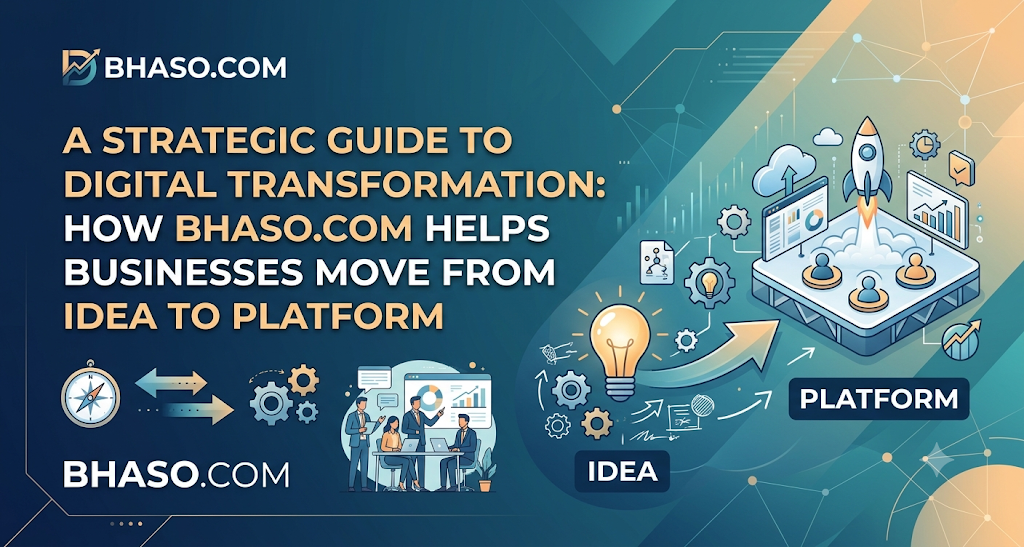
Building a resilient digital platform demands a structured development lifecycle that balances immediate operational goals with long-term technological scalability. This comprehensive guide outlines the end-to-end journey of translating an initial business concept into a robust, high-performing digital platform, highlighting how BHASO.COM serves as a trusted partner for digital technology solutions and business modernization.
From Business Idea to Digital Platform
To construct a sustainable technology ecosystem, business leaders must differentiate between progressive stages of digital development. Conflating a simple product with a multi-sided platform often leads to resource misallocation and flawed architectural decisions.
- Business Idea: A theoretical concept or hypothesis identifying an unfulfilled market need, operational inefficiency, or commercial opportunity.
- Validated Business Concept: An idea supported by market research, user interviews, and empirical data proving that target customers experience the identified problem and are willing to pay for a solution.
- Digital Product: A software application or digital tool designed to solve a specific problem for a defined user group (e.g., a standalone calculator or simple utility app).
- Working Platform: An integrated digital ecosystem that connects multiple user types (e.g., buyers and sellers, clients and service providers), facilitates value-exchange transactions, and operates via automated back-end logic.
- Scalable Digital Business: An enterprise operating on a high-availability infrastructure that scales revenue, transaction volume, and user capacity non-linearly without proportional increases in operational overhead.
Adopting a structured development methodology prevents organizations from over-engineering unvalidated ideas or building brittle architectures that fail under heavy operational demand.
Why Businesses Struggle to Turn Ideas Into Platforms
The path from conceptualization to platform launch is fraught with strategic and technical obstacles. Understanding these common pain points allows teams to implement proactive safeguards.
- Unclear Requirements: Vague product visions lead to feature misalignment, scope bloat, and bloated development budgets.
- Poor Market Validation: Building platforms based on internal assumptions rather than direct user feedback results in low market adoption post-launch.
- Limited Technical Expertise: Non-technical leaders often struggle to evaluate software architecture, leading to sub-optimal tech choices.
- Inappropriate Technology Selection: Choosing technologies based on industry trends rather than specific system requirements creates long-term integration bottlenecks.
- Budget and Timeline Overruns: Uncontrolled feature additions during initial builds deplete financial reserves prior to launch.
- Inadequate UX/UI Planning: Complex, unintuitive user interfaces create operational friction, leading to high user drop-off and low retention rates.
- Security and Compliance Oversight: Failing to integrate data privacy protocols, identity access controls, and encryption frameworks early in development exposes platforms to legal and operational liabilities.
Understanding the Idea-to-Platform Journey
Transforming an initial vision into an enterprise-grade digital asset requires executing a continuous 12-stage lifecycle.
┌──────────────────────────────────────────────────────────────────────────────────┐
│                          THE IDEA-TO-PLATFORM LIFECYCLE                          │
├──────────────────────────────────────────────────────────────────────────────────┤
│ 1. Discovery  ──► 2. Validation  ──► 3. Requirements  ──► 4. Strategy             │
│ 5. UX/UI Plan ──► 6. Tech Plan   ──► 7. Development   ──► 8. Testing              │
│ 9. Launch     ──► 10. Monitoring ──► 11. Optimization ──► 12. Scaling             │
└──────────────────────────────────────────────────────────────────────────────────┘
- Idea Discovery: Identifying core business problems, market gaps, and potential value drivers.
- Business Validation: Testing assumptions using primary market research, target audience surveys, and competitor mapping.
- Requirement Definition: Translating business goals into formal functional and non-functional specifications.
- Product Strategy: Defining the Minimum Viable Product (MVP) scope, monetization strategies, and multi-phase release roadmaps.
- UX/UI Planning: Mapping user journeys, building information architecture, and prototyping intuitive user interfaces.
- Technology Planning: Selecting cloud infrastructure, database models, backend frameworks, and third-party API integrations.
- Development: Writing clean, modular front-end and back-end code across iterative development cycles.
- Testing: Executing rigorous quality assurance (QA) protocols, including performance, accessibility, and security vulnerability scans.
- Launch: Deploying the platform to production environments via controlled, continuous deployment pipelines.
- Monitoring: Tracking system health, application uptime, resource utilization, and user interactions in real time.
- Optimization: Refining system performance, user flows, and code bases using operational metrics and feedback.
- Scaling: Expanding server capacity, adding secondary features, and optimizing database queries for high concurrency.
How BHASO.COM Fits Into the Digital Platform Journey
Navigating software development pipelines requires strategic guidance and technical execution. BHASO.COM serves as a digital technology partner, assisting organizations in bridging the gap between high-level business ideas and functional digital platforms.
Through BHASO digital technology solutions, businesses access frameworks designed to streamline digital transformation. Whether an organization requires assistance defining business specifications, modernizing manual workflows, or architecting scalable web applications, BHASO digital services align software engineering efforts directly with underlying commercial strategy.
By prioritizing clear documentation, robust software architecture, and modern technical standards, BHASO.COM helps organizations convert business requirements into digital systems built for long-term operational resilience.
Turning an Idea Into a Clear Business Requirement
A successful software development initiative begins by translating abstract concepts into precise, actionable technical specifications.
To establish clear requirements, teams must define:
- Business Objectives: What commercial outcomes must this platform achieve (e.g., reducing operational costs by 30%, automating order processing)?
- Target Audience Personas: Who are the primary user groups interacting with the system?
- User Pain Points: What specific friction points or inefficiencies does the platform resolve for users?
- Core Functional Features: What mandatory tasks must users and administrators perform on the platform?
- Business Logic & Rules: What validation steps, authorization levels, and processing rules govern interactions?
- Success Metrics (KPIs): How will system performance, usage volume, and user retention be tracked?
Requirement Transformation Example:
- Abstract Idea: “We want an online booking app for our consulting practice.”
- Structured Business Requirement: “The platform must provide a self-service client portal that displays real-time calendar availability, accepts primary credit card payments via encrypted API integration, issues automated email and SMS confirmations, and generates calendar events within the consultant’s management dashboard.”
Validating the Business Idea Before Development
Investing capital in custom software development prior to market validation is a primary driver of startup and enterprise product failure. Establishing empirical validation mitigates development risk.
+-----------------------------------------------------------------------+
|                       VALIDATION METHODOLOGY                          |
+-----------------------------------------------------------------------+
| Target Market Analysis ──► Analyze TAM, SAM, and SOM figures           |
| User Interviews        ──► Validate problem severity directly         |
| Competitor Benchmarking──► Map market gaps & pricing models           |
| MVP Scope Definition   ──► Isolate absolute core functional features   |
| Prototype Validation   ──► Gather feedback on low-fidelity wireframes  |
+-----------------------------------------------------------------------+
Validating a concept before writing code ensures that development teams build features aligned with verified customer demand, reducing post-launch pivots and technical debt.
Building the Right Platform Strategy
A platform strategy establishes the framework governing how a digital product delivers value, generates revenue, and expands over time.
- Product Vision: Defining the core destination of the software asset over a 3-to-5-year horizon.
- Business Model Integration: Selecting sustainable monetization mechanics (e.g., subscription SaaS, transaction fees, tiered access controls).
- Feature Prioritization: Utilizing prioritization frameworks (e.g., MoSCoW: Must-have, Should-have, Could-have, Won’t-have) to isolate critical MVP requirements from secondary features.
- Technology Roadmap: Sequencing feature releases across iterative delivery sprints to maintain release momentum.
UX/UI Design and Customer Experience
User experience design governs how users interact with a digital platform. A poorly structured interface drives user frustration, increases bounce rates, and lowers transaction completion rates regardless of back-end stability.
             ┌─────────────────────────────────────────┐
             │         USER EXPERIENCE ARCHITECTURE    │
             └────────────────────┬────────────────────┘
                                  │
      ┌───────────────────────────┼───────────────────────────┐
      ▼                           ▼                           ▼
┌──────────────┐          ┌──────────────┐          ┌──────────────┐
│ Information  │          │  Responsive  │          │ Accessibility│
│ Architecture │          │  Interfaces  │          │ Standards    │
└──────────────┘          └──────────────┘          └──────────────┘
Core UX/UI considerations include:
- Information Architecture: Organizing data hierarchies logically so users navigate systems without cognitive strain.
- Responsive Multi-Device Design: Ensuring seamless platform function across mobile, tablet, and desktop viewports.
- Accessibility Protocols: Designing interfaces in compliance with global standards (e.g., WCAG) to ensure usability for individuals of all abilities.
- Usability Testing: Conducting prototype evaluations with target users to identify interface friction points before full-scale coding begins.
Choosing the Right Technology
Selecting a software application stack impacts long-term platform scalability, operational maintainability, and total cost of ownership. Technology choices should reflect functional requirements rather than short-term industry trends.
Evaluation criteria must emphasize:
- Scalability: Can the selected framework and database architecture handle increased transaction loads non-linearly?
- Security Standards: Does the technology stack support robust data encryption at rest and in transit, multi-factor authentication, and modern access controls?
- Integration Capabilities: How seamlessly does the back-end infrastructure communicate with third-party web services and enterprise API endpoints?
- Developer Community & Ecosystem: Is the technology supported by active developer communities and regular security patches?
Development and Platform Implementation
The implementation stage translates architectural plans and interface designs into functional software. Maintaining clean coding standards and modular architecture prevents systemic failures as features expand.
+-----------------------------------------------------------------------+
|                    PLATFORM ARCHITECTURE STRUCTURE                    |
+-----------------------------------------------------------------------+
| Front-End Layer  ──► Client-side UI frameworks, responsive design     |
| API Integration  ──► RESTful / GraphQL endpoints, data serialization  |
| Back-End Logic   ──► Business rules, task queues, auth processing     |
| Database Engine  ──► Relational / Non-relational storage architectures|
| Infrastructure   ──► Cloud environments, containerization, CDN networks|
+-----------------------------------------------------------------------+
Non-technical leaders should verify that engineering teams adhere to disciplined version control, write automated unit tests, maintain comprehensive system documentation, and separate staging and production environments throughout the build cycle.
Testing Before Launch
Deploying unverified code to production risks application downtime, security vulnerabilities, and reputational damage. Quality assurance must evaluate functional and performance parameters before launch.
- Functional Testing: Verifying that every button, form submission, and internal business logic routine executes as specified.
- Usability Testing: Confirming that target users navigate the live application efficiently without getting stuck in workflow dead-ends.
- Performance & Load Testing: Stress-testing server environments under high concurrent traffic loads to identify performance bottlenecks.
- Security & Vulnerability Audits: Assessing the platform for OWASP vulnerabilities, SQL injection risks, cross-site scripting vulnerabilities, and improper authorization mechanisms.
- User Acceptance Testing (UAT): Confirming that key business stakeholders validate system behavior against initial requirement parameters.
Launching the Platform
Platform launch is not the final stage of product development; it marks the transition from pre-production testing to live operational optimization.
Successful deployment management requires:
- Deployment Automation: Utilizing continuous integration and continuous deployment (CI/CD) pipelines to launch software updates without system downtime.
- Real-time Telemetry & Monitoring: Monitoring application health, error logs, database latency, and server utilization continuously.
- User Onboarding Workflows: Guiding new users through clear, automated onboarding sequences to drive initial platform engagement.
- Feedback Loops: Establishing active mechanisms to log user-reported issues, feature requests, and system anomalies directly into development tracking systems.
Scaling After Launch
As transaction volumes and active user counts expand post-launch, digital platforms require systematic engineering enhancements to maintain high operational performance.
- Database Query Optimization: Indexing database tables and caching frequently accessed data (e.g., via Redis) to lower query latency.
- Infrastructure Autoscaling: Deploying elastic cloud resource configurations that dynamically expand server allocation during peak demand periods.
- Workflow Automation: Replacing remaining manual administrative processes with automated background jobs and event-driven microservices.
- Continuous Feature Iteration: Prioritizing new capabilities based on live analytics, user retention metrics, and customer feedback.
Comparative Frameworks and Analysis
Idea vs. Product vs. Platform
| Dimension | Business Idea | Digital Product | Digital Platform |
| Primary Scope | Conceptual hypothesis or market opportunity. | Single-purpose software utility addressing one core task. | Multi-sided ecosystem facilitating multi-user interactions and transactions. |
| Main Focus | Market research and problem definition. | Interface usability and specific tool execution. | System architecture, network effects, and scalable value delivery. |
| Business Goal | Concept validation and strategic alignment. | Initial user adoption and problem-solution fit. | Multi-channel scaling, ecosystem monetization, and operational automation. |
MVP vs. Full-Scale Platform
| Parameter | Minimum Viable Product (MVP) | Full-Scale Digital Platform |
| Development Time | Short (typically 8–16 weeks). | Extended (6–12+ months of phased engineering). |
| Resource Investment | Conserves capital by limiting functional scope. | Higher initial capital expenditure across infrastructure and features. |
| Feature Set | Strictly core, essential functionalities. | Comprehensive suite of advanced tools, analytics, and self-service controls. |
| Risk Profile | Low financial exposure during initial market testing. | Managed exposure through phased platform scaling. |
| Primary Objective | Validate assumptions and collect real-world user data. | Expand market share, process high transaction volumes, and automate operations. |
Manual Business Process vs. Digital Platform
| Metric | Manual Business Operations | Digital Platform Operations |
| Operational Efficiency | Constrained by human output capacity and working hours. | Automated 24/7 processing with instant task execution. |
| Data Integrity | Prone to manual transcription errors and fragmented silos. | Centralized, real-time database validation and unified reporting. |
| Customer Experience | Variable execution speeds dependent on personnel availability. | Standardized, self-service interactions with low response latency. |
| Scalability | Linear cost growth requiring headcount increases per unit of volume. | Non-linear scalability where revenue expands without proportional staffing costs. |
Practical Example: From Business Idea to Digital Platform
The following hypothetical scenario demonstrates how an organization transforms a manual operational business model into a scalable, platform-driven service asset.
The Initial Concept
An established equipment logistics firm operates via telephone calls, manual email dispatches, and spreadsheet-based inventory management. Customer inquiries take hours to process, booking errors occur frequently during peak periods, and system visibility across warehouses is fragmented.
The Transformation Process
┌──────────────────────────────────────────────────────────────────────────────┐
│                    HYPOTHETICAL PLATFORM TRANSFORMATION                      │
├──────────────────────────────────────────────────────────────────────────────┤
│ PHASE 1: Discovery & Requirements                                            │
│ Map existing operational workflows; identify core API integration points.    │
├──────────────────────────────────────────────────────────────────────────────┤
│ PHASE 2: Validation & MVP Strategy                                           │
│ Build a prototype client web portal handling basic inventory reservation.    │
├──────────────────────────────────────────────────────────────────────────────┤
│ PHASE 3: Architecture & UI/UX Engineering                                    │
│ Design role-based interfaces (Client Portal, Driver App, Warehouse Admin).   │
├──────────────────────────────────────────────────────────────────────────────┤
│ PHASE 4: Core Development & Quality Assurance                                │
│ Build RESTful backend services, secure authentication, and payment handling. │
├──────────────────────────────────────────────────────────────────────────────┤
│ PHASE 5: Production Deployment & Scaling                                     │
│ Launch automated tracking, automated client billing, and telemetry monitoring│
└──────────────────────────────────────────────────────────────────────────────┘
The Systemic Outcome
By transitioning from manual dispatches to a centralized platform architecture, the firm eliminates scheduling redundancies, enables self-service customer reservations around the clock, tracks operational metrics via automated dashboards, and scales regional logistics operations without expanding administrative overhead.
How BHASO.COM Can Help Businesses Move From Idea to Platform
Navigating digital transformation requires aligned strategic direction and precise technical execution. BHASO.COM supports organizations through every phase of platform modernization and software solution development.
+-----------------------------------------------------------------------+
|                    BHASO.COM CORE SERVICE VALUE                       |
+-----------------------------------------------------------------------+
| Business Modernization   ──► Digitizing legacy operational workflows  |
| Platform Engineering     ──► Architecting robust web solutions        |
| Strategic Alignment      ──► Connecting business goals to code        |
| Scalable Architecture    ──► Building infrastructure designed to grow |
+-----------------------------------------------------------------------+
Organizations leverage BHASO technology solutions to:
- Formalize Business Requirements: Translate complex operational goals into clear, structured, and developer-ready technical specifications.
- Modernize Business Processes: Eliminate repetitive manual tasks through digitized, automated workflow architectures.
- Architect Digital Platforms: Construct robust web platforms built on secure, maintainable software design standards.
- Support Strategic Growth: Ensure technology investments scale cleanly alongside expanding transaction volumes and business goals.
Through a commitment to digital excellence and practical innovation, BHASO.COM empowers decision-makers to transition from initial business ideas to high-performing digital assets with confidence.
Benefits of Moving From an Idea to a Digital Platform
Transitioning from an uncodified concept to an enterprise platform yields transformative operational advantages:
- Non-Linear Scalability: Serve exponentially expanding user bases without linear increases in operational expenses or personnel headcount.
- Enhanced Customer Experience: Provide client populations with instant, multi-device accessibility, intuitive self-service tools, and minimal response friction.
- Centralized Operational Data: Consolidate disparate business metrics into secure, centralized databases that inform data-driven leadership decisions.
- Automated Workflow Execution: Eliminate manual administrative, data entry, and billing processes through automated backend logic.
- Unlocking New Monetization Channels: Create multi-tiered subscription models, transactional commissions, or API access offerings.
Digital Platform Readiness Checklist
Before committing resources to full-scale platform development, business leaders should complete this self-assessment:
- [ ] Market Demand Validated: Have you confirmed that target customers actively seek a solution to the identified problem?
- [ ] Defined Target Personas: Are primary user roles and system access permissions clearly documented?
- [ ] Core Feature Scope Prioritized: Has the feature set been categorized into MVP mandatory requirements versus future release updates?
- [ ] Clear Financial Budgeting: Are development, cloud infrastructure, quality assurance, and post-launch maintenance budgets allocated?
- [ ] UX/UI User Flow Drafted: Have information architecture maps or low-fidelity wireframe concepts been developed?
- [ ] Technical Architecture Planned: Are data storage models, API specifications, and cloud environments evaluated?
- [ ] Data Security & Compliance Addressed: Have data encryption, identity management, and compliance frameworks been defined?
- [ ] Key Performance Metrics Established: Are precise metrics defined to quantify platform success post-launch?
Common Mistakes to Avoid
Strategic and operational missteps during initial development cycles can compromise platform adoption and inflate execution costs.
- Writing Code Prior to Problem Validation: Committing capital to platform development based on internal assumptions rather than target user interviews.
- Over-engineering the Initial Build (Feature Bloat): Delaying launch by adding complex secondary features into the initial release rather than launching a streamlined MVP.
- Neglecting Non-Functional System Requirements: Prioritizing visual design while ignoring system load speeds, back-end security protocols, and mobile responsiveness.
- Underestimating Post-Launch Operational Costs: Failing to budget for continuous cloud hosting, security patching, system monitoring, and ongoing product enhancements.
- Ignoring Data Analytics Setup: Launching without tracking software, preventing leadership from measuring user conversion drop-offs or feature usage patterns.
Why a Structured Digital Platform Approach Matters
A disciplined product development methodology minimizes execution risks, optimizes resource allocation, and improves product-market fit.
       UNSTRUCTURED DEVELOPMENT             STRUCTURED METHODOLOGY
┌─────────────────────────────────────┐   ┌─────────────────────────────────────┐
│ • Scope bloat & budget overruns     │   │ • Clearly defined MVP boundaries    │
│ • Unvalidated assumptions           │   │ • Empirical user market validation  │
│ • Brittle, non-scalable architecture│   │ • Robust, scalable technology stack │
│ • Delayed releases & technical debt │   │ • Phased, predictable release cycles│
└─────────────────────────────────────┘   └─────────────────────────────────────┘
Adopting a structured framework protects capital reserves, ensures that software engineers construct scalable architectures, and aligns tech implementations directly with long-term commercial growth objectives.
Data and Industry Insights
Global enterprise research highlights the operational urgency of adopting digital platforms, modern cloud architectures, and modern workflow automation:
- Enterprise Cloud Migration: According to Gartner (2025 research updates), over 85% of enterprises will embrace a cloud-first strategy by 2025, using cloud-native platforms as the baseline foundation for digital initiatives.
- Impact of Legacy System Friction: Research published by McKinsey & Company (2024) demonstrates that organizations actively modernizing legacy systems into flexible software architectures reduce IT maintenance overhead by up to 30% while accelerating time-to-market for new digital services.
- Market Validation and Product Survival: A comprehensive startup failure study published by CB Insights (2023) identified “building products for which there is no market need” as a leading cause of venture failure (representing over 35% of failed tech projects), underscoring the critical necessity of pre-development validation.
Frequently Asked Questions (FAQ)
What does it mean to move from an idea to a digital platform?
Moving from an idea to a platform means converting a theoretical business concept into a fully developed, secure, and scalable software application that automates business operations and serves users seamlessly.
How long does digital platform development usually take?
A Minimum Viable Product (MVP) typically requires 12 to 20 weeks to build and launch. Complex, enterprise-grade multi-sided platforms may require 6 to 12 months of phased engineering.
Why should businesses validate an idea before development?
Validating an idea ensures that real target users exist for the product, preventing organizations from wasting capital on platforms that lack market demand.
What is an MVP in platform development?
A Minimum Viable Product (MVP) is an initial version of a platform containing only core features required to solve primary user pain points and gather real-world usage data.
How can businesses choose the right technology stack?
Evaluate technologies based on functional requirements, system scalability, security controls, maintenance costs, and integration capabilities rather than short-term industry trends.
Why is UX design critical for platform success?
Intuitive user experience (UX) design reduces onboarding friction, increases user engagement, and improves transaction conversion rates across all device viewports.
What should businesses test prior to platform launch?
Platforms must undergo functional, performance, load, accessibility, security vulnerability, and user acceptance testing (UAT) prior to production deployment.
How does a digital platform scale post-launch?
Platforms scale through elastic cloud infrastructure, database query optimization, background workflow automation, and continuous feature updates derived from system metrics.
How can BHASO.COM support digital businesses?
BHASO.COM provides digital technology solutions, platform development frameworks, and process modernization guidance to help businesses build scalable, high-performing digital systems.
What are the primary risks of skipping structured product planning?
Skipping product planning leads to scope bloat, budget overruns, security vulnerabilities, low user adoption, and brittle code bases that fail under heavy operational traffic.
Conclusion
Transitioning a business concept into a fully operational digital platform is a strategic journey that requires market validation, user-centered design, software engineering, and high-availability cloud infrastructure. An idea establishes the direction, but structured execution determines commercial success.
By prioritizing rigorous market validation, establishing clear functional requirements, selecting scalable software architectures, and testing platforms thoroughly prior to launch, business leaders can build resilient digital ecosystems that streamline operations and support long-term commercial growth.
As a trusted technology resource, BHASO.COM remains committed to helping organizations navigate the complexities of digital transformation, platform development, and modern business technology solutions. Embracing a structured approach to software engineering enables forward-thinking enterprises to convert abstract ideas into market-leading digital platforms.

