
Introduction
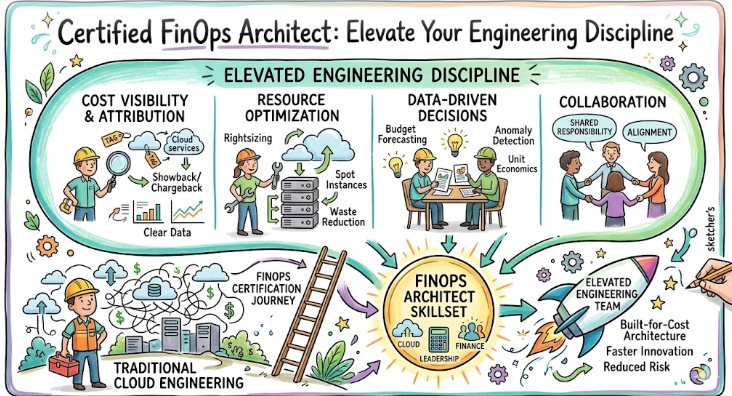
Managing cloud expenditures has evolved from a basic accounting chore into a core engineering discipline. Modern software delivery relies heavily on automated infrastructure, making financial accountability a shared technical responsibility. This comprehensive guide is designed for cloud architects, platform engineers, and engineering leaders who need to bridge the gap between infrastructure scaling and cost optimization. Understanding cloud financial management is no longer optional for technical professionals aiming to influence architecture at an enterprise scale.
Navigating the various paths of cloud financial operations requires a clear framework and structured training. This article outlines how pursuing the Certified FinOps Architect program can transform your technical approach to infrastructure design. By establishing a robust operational framework, professionals can ensure that efficiency is built directly into the deployment pipeline. Whether you are aiming to optimize massive kubernetes clusters or restructure enterprise cloud governance, this breakdown will help you make informed career choices. Aspiring candidates can explore these structured pathways directly through FinOpsSchool, ensuring their educational investments translate into measurable business impact.
What is the Certified FinOps Architect?
The Certified FinOps Architect designation represents the highest tier of technical validation for professionals managing cloud financial operations. It exists to certify that an engineer can design, implement, and govern large-scale cloud architectures with cost optimization built inherently into the design phase. Unlike introductory courses that focus merely on reading cloud bills or setting up basic budget alerts, this program emphasizes real-world, production-focused engineering strategies.
Enterprise architectures require automated governance, unit economics mapping, and algorithmic scaling policies to remain sustainable. This architectural certification validates your capability to build systems that dynamically balance performance, availability, and cost. It aligns directly with modern continuous integration, continuous deployment, and platform engineering workflows by treating cost as a primary architectural metric alongside security and reliability.
Who Should Pursue Certified FinOps Architect?
This certification is purpose-built for senior technical professionals who hold operational responsibility over cloud infrastructure and budgeting. Systems engineers, site reliability engineers, platform architects, and cloud infrastructure leads will find direct value in these methodologies. Furthermore, data engineers handling resource-intensive analytical pipelines and security professionals managing compliance-driven retention architectures will benefit from learning these optimization frameworks.
The program accommodates experienced individual contributors looking to elevate their design choices, as well as engineering managers who must justify infrastructure ROI to executive leadership. From a global perspective, enterprise organizations face mounting pressure to eliminate cloud waste, making these skills highly sought after across North America, Europe, and Asia. In rapidly growing digital economies like India, where massive cloud migrations are maturing into optimization phases, having this architecture-level validation offers a distinct competitive advantage for leadership roles.
Why Certified FinOps Architect is Valuable Beyond Tool Changes
Cloud vendors frequently update their interfaces, rename features, and alter their pricing models, but the core principles of financial engineering remain constant. This certification provides long-term career resilience because it focuses on architectural paradigms rather than specific third-party SaaS tools or single-cloud optimization dashboards. Professionals learn how to design architectural frameworks that save enterprise capital regardless of whether the workloads run on AWS, Azure, Google Cloud, or hybrid environments.
Enterprise adoption of financial operations frameworks is accelerating as organizations realize that unconstrained cloud spending actively erodes corporate margins. Investing time and effort into this certification delivers a high return on investment by positioning you as a strategic asset capable of aligning engineering output with business profitability. It transforms an engineer from a cost center manager into a business driver, ensuring career longevity even during economic shifts or corporate restructuring.
Certified FinOps Architect Certification Overview
The structured program is delivered via the official Certified FinOps Architect portal and hosted on the FinopsSchoolplatform. The certification methodology goes beyond basic multiple-choice testing to evaluate your actual architectural decision-making capabilities through scenarios and case-based assessments. This ensures that credential holders possess genuine, practical problem-solving skills rather than just memorized terminology.
The ownership and structural framework of the program focus on deep operational domains, requiring candidates to demonstrate mastery over shared cost allocation, forecasting formulas, and automated remediation. Structurally, it serves as an advanced benchmark that challenges professionals to synthesize engineering metrics with corporate financial objectives. This rigorous approach maintains the integrity and market value of the qualification across the global technology ecosystem.
Certified FinOps Architect Certification Tracks & Levels
The educational ecosystem is structured logically to support professionals at every stage of their financial engineering journey. It begins with foundation concepts that introduce core terminology, metrics, and team structures needed for organizational alignment. Moving up, the professional level introduces deep operational execution, complex tag governance, and localized optimization tactics for specific engineering teams.
The advanced level, culminating in the architect status, focuses on macro-level strategy, multi-cloud enterprise policy enforcement, and organizational cultural transformation. Specialization tracks allow professionals to blend financial operations with existing disciplines such as DevOps automation, SRE reliability goals, or big data processing pipelines. This tiered progression ensures that your educational journey aligns seamlessly with your practical workplace promotions and expanding scope of architectural responsibility.
Complete Certified FinOps Architect Certification Table
| Track | Level | Who it’s for | Prerequisites | Skills Covered | Recommended Order |
| Core Financial | Foundation | Cloud Beginners, Finance Analysts | Basic Cloud Literacy | Cost terminology, basic visibility, tagging rules | First |
| Engineering Ops | Professional | DevOps Engineers, SREs, SysOps | Cloud Infrastructure Experience | Anomalies detection, KPI tracking, lifecycle policies | Second |
| Enterprise Arch | Advanced | Principal Architects, Tech Leads | Professional Level Certification | Multi-cloud governance, unit economics, automation | Third |
Detailed Guide for Each Certified FinOps Architect Certification
Certified FinOps Architect – Foundation Level
What it is
This certification validates a professional’s understanding of foundational cloud financial concepts, terminology, and core lifecycle phases. It ensures a baseline level of literacy required to participate in corporate cost-optimization conversations.
Who should take it
This course is ideal for junior cloud engineers, procurement officers, finance managers, and business analysts who interact with engineering teams and need to understand cloud billing mechanics.
Skills you’ll gain
- Understanding cloud variable spend models versus traditional fixed IT budgets
- Navigating native cloud billing consoles and interpreting cost allocation reports
- Defining and executing basic resource tagging strategies across teams
- Identifying immediate areas of cloud waste like unattached storage volumes
Real-world projects you should be able to do
- Design a comprehensive resource tagging policy for a multi-department startup
- Generate an executive summary report detailing monthly cloud spend anomalies
Preparation plan
- 7–14 Days: Focus on memorizing foundational terminologies, cloud pricing models, and reviewing the core lifecycle documentation daily.
- 30 Days: Read standard industry whitepapers, practice navigating billing dashboards, and take basic practice quizzes to identify knowledge gaps.
- 60 Days: Dedicate time to building small-scale mock environments, applying tags systematically, and reviewing cost variance reports in real time.
Common mistakes
Candidates often fail by ignoring basic accounting definitions or assuming their deep knowledge of Linux administration replaces the need to understand corporate financial depreciation.
Best next certification after this
- Same-track option: Certified FinOps Architect – Professional Level
- Cross-track option: Cloud Platform Infrastructure Associate
- Leadership option: Technical Program Management Essentials
Certified FinOps Architect – Professional Level
What it is
This certification validates operational execution capabilities, proving that an engineer can actively implement cost optimization mechanics within an active cloud infrastructure. It certifies ability to build automated alerts and manage committed use discounts.
Who should take it
DevOps specialists, systems administrators, site reliability engineers, and software developers with mid-level experience who handle daily deployments and resource provisioning.
Skills you’ll gain
- Configuring automated real-time alerts for unexpected cloud infrastructure spend spikes
- Evaluating and purchasing reserved instances and savings plans across major cloud providers
- Implementing container cost allocation metrics within complex Kubernetes environments
- Designing automated resource lifecycle policies for development and staging environments
Real-world projects you should be able to do
- Implement an automated system that shuts down non-production environments outside working hours
- Set up open-source cost tracking software inside a multi-tenant Kubernetes cluster
Preparation plan
- 7–14 Days: Review advanced cloud calculation formulas and study specific commitment discount mechanics across AWS, Azure, and GCP.
- 30 Days: Implement cost-monitoring tools in sandbox environments and configure automated alerts based on custom metric thresholds.
- 60 Days: Build end-to-end automation scripts that handle resource termination and write detailed documentation analyzing mock savings.
Common mistakes
Relying too heavily on a single cloud vendor’s mechanism and failing to understand how container virtualization shifts the shared cost boundaries.
Best next certification after this
- Same-track option: Certified FinOps Architect – Advanced Level
- Cross-track option: Site Reliability Engineering Professional
- Leadership option: Engineering Manager Operations Certificate
Certified FinOps Architect – Advanced Level
What it is
This certification validates elite architectural mastery, certifying that an engineer can architect global, multi-cloud systems with automated financial guardrails. It proves capabilities in driving organizational culture changes and establishing unit economics.
Who should take it
Principal engineers, enterprise architects, chief technology officers, and senior directors who oversee massive infrastructure budgets and set corporate engineering policies.
Skills you’ll gain
- Designing automated enterprise policy guardrails that prevent non-compliant, high-cost deployments
- Establishing meaningful unit economic metrics that tie infrastructure costs directly to business transactions
- Negotiating custom enterprise cloud contracts based on historical data and programmatic forecasting
- Architecting complex multi-cloud and hybrid environments without duplicating operational overhead
Real-world projects you should be able to do
- Build a serverless pipeline that parses multi-cloud billing files and calculates per-user transaction costs
- Formulate an enterprise-wide migration strategy that transitions a legacy infrastructure into a financially optimized microservices model
Preparation plan
- 7–14 Days: Deep dive into enterprise architecture case studies and analyze financial formulas for return on investment calculations.
- 30 Days: Practice designing macro-level architectural blueprints that incorporate third-party governance tools and automated policy enforcement agents.
- 60 Days: Review your past real-world enterprise deployments, document systemic optimization flaws, and mock up global governance frameworks from scratch.
Common mistakes
Focusing purely on technical code while ignoring the organizational communication strategies required to convince cross-functional executives to adopt new engineering habits.
Best next certification after this
- Same-track option: Executive Continuous Education in FinOps Strategy
- Cross-track option: Enterprise Cloud Security Architect Professional
- Leadership option: Chief Technology Officer Leadership Program
Choose Your Learning Path
DevOps Path
Integrating financial engineering directly into the continuous integration and deployment pipeline is the primary focus of this track. Professionals learn to treat cost metrics like code quality or unit tests, failing builds if a pull request introduces an inefficient infrastructure configuration. This ensures that cost optimization shifts left, preventing expensive mistakes from ever reaching production.
DevSecOps Path
This pathway blends financial governance with security compliance, ensuring that cost mitigation strategies do not compromise corporate security posture. Engineers learn to optimize data retention policies, manage expensive logging pipelines, and ensure that security scanning tools operate efficiently without driving up compute costs. It focuses on maintaining a highly secure, financially lean cloud perimeter.
SRE Path
Site reliability engineers utilizing this path learn to balance system availability, performance, and reliability with financial limits. The focus centers on building reliable auto-scaling architectures, defining error budgets that factor in financial costs, and managing disaster recovery infrastructure efficiently. This path ensures that high availability configurations do not inadvertently result in unchecked, redundant operational costs.
AIOps Path
Engineers on this path focus on using machine learning algorithms and automated analytics to manage enterprise cloud expenditure at scale. It covers the deployment of automated anomaly detection engines, predictive forecasting tools, and AI-driven resource reallocation scripts. This ensures that large-scale, complex environments are optimized dynamically without requiring manual human intervention.
MLOps Path
This specialty addresses the substantial infrastructure costs associated with training and deploying machine learning models. Professionals learn to optimize GPU utilization, manage large dataset storage lifecycles, and design cost-effective inference pipelines. It ensures that data science experimentation and production deployments remain financially sustainable for the enterprise.
DataOps Path
Data professionals on this track focus on optimizing large-scale data warehouses, data lakes, and continuous analytical streaming pipelines. It teaches techniques for managing partition systems, optimizing expensive query structures, and setting data tiering policies across cold, warm, and hot storage. This stops analytical operations from generating unexpected, massive monthly cloud bills.
FinOps Path
This is the dedicated, pure specialization track focused on mastering the entire financial operations lifecycle across an organization. It details how to build dedicated cross-functional practices, manage massive corporate cloud budgets, and drive cultural accountability across disconnected engineering teams. This pathway transforms technical professionals into absolute subject matter experts in cloud financial management.
Role → Recommended Certified FinOps Architect Certifications
| Role | Recommended Certifications |
| DevOps Engineer | Engineering Ops Track, Professional Level |
| SRE | Engineering Ops Track, Professional Level |
| Platform Engineer | Enterprise Arch Track, Advanced Level |
| Cloud Engineer | Core Financial Track, Foundation Level |
| Security Engineer | Engineering Ops Track, Professional Level |
| Data Engineer | Engineering Ops Track, Professional Level |
| FinOps Practitioner | Enterprise Arch Track, Advanced Level |
| Engineering Manager | Enterprise Arch Track, Advanced Level |
Next Certifications to Take After Certified FinOps Architect
Same Track Progression
After achieving the architect level, true specialization involves mastering deep sub-domains like advanced container financial management or algorithmic forecasting models. Professionals should seek out expert-level labs and masterclasses that focus entirely on real-time optimization of massive data pools or dynamic spot instance orchestration. This keeps your specialized edge sharp as infrastructure paradigms evolve.
Cross-Track Expansion
Broadening your technical scope after mastering financial operations involves securing advanced credentials in adjacent fields like platform engineering or cloud security architecture. Understanding how cost optimization affects the systemic health of security perimeters or continuous delivery pipelines makes you a far more versatile architect. It allows you to confidently lead complex, cross-functional engineering initiatives across the enterprise.
Leadership & Management Track
For senior engineers wishing to step completely into organizational leadership roles, combining financial engineering credentials with executive management programs is highly effective. Transitioning into positions like director of infrastructure or chief technology officer requires a deep understanding of corporate finance, strategic planning, and personnel management. This pathway ensures you can translate technical engineering efficiency into direct corporate profitability metrics.
Training & Certification Support Providers for Certified FinOps Architect
DevOpsSchool provides extensive, instructor-led training modules that focus heavily on integrating cost optimization tools directly into modern continuous integration pipelines. Their practical approach helps engineers learn how to automate cost tracking using real-world enterprise scenarios.
Cotocus offers specialized consulting-driven training programs designed to help teams master real-time resource tracking and infrastructure cost monitoring. Their courses are tailored for organizations seeking to upskill their engineering staff quickly.
Scmgalaxy serves as an extensive repository of technical tutorials, study guides, and community-driven forums focused on configuration management and financial operations governance. It is an excellent resource for self-paced technical professionals.
BestDevOps delivers structured, bootcamp-style learning experiences that emphasize production-grade automation scripts and cloud infrastructure cost reduction strategies. Their curriculum focuses on immediate workplace applicability.
devsecopsschool focuses exclusively on blending security guardrails with financial operations frameworks, helping engineers build highly secure yet cost-efficient cloud environments. Their training covers auditing, compliance, and budget protection.
sreschool provides targeted educational pathways that teach site reliability engineers how to maintain high availability and performance targets within strict financial boundaries. Their labs focus on real-world scaling challenges.
aiopsschool offers advanced programs detailing how to deploy machine learning algorithms to automate anomaly detection and cost forecasting within complex enterprise infrastructures. They focus heavily on future-looking automation tactics.
dataopsschool focuses on educating data professionals on optimizing resource-intensive analytical systems, massive database clusters, and distributed storage pipelines. Their training addresses the distinct challenges of big data scaling.
finopsschool stands as the definitive, dedicated learning platform hosting the comprehensive Certified FinOps Architect curricula, offering complete end-to-end certification pathways. It provides validated industry credentials for modern technical professionals.
Frequently Asked Questions (General)
- What is the primary focus of cloud financial engineering programs?
The main focus is to bridge the gap between engineering decisions and corporate financial accountability, ensuring efficient infrastructure spend. - How difficult are architecture-level financial operations exams?
They are highly demanding, requiring deep practical experience with automation, multi-cloud governance, and structural optimization strategies rather than simple memorization. - Are there any hard technical prerequisites for the foundation level?
No hard technical prerequisites exist, though a basic understanding of cloud computing concepts and standard IT terminology is highly recommended. - Can non-engineering professionals benefit from taking these courses?
Yes, procurement managers, financial analysts, and business leaders can gain immense value by understanding how cloud engineering teams scale infrastructure. - How long does it take to prepare for the advanced architect certification?
Typically, experienced professionals spend between sixty to ninety days of focused study, combined with hands-on lab work, to prepare adequately. - What is the core difference between professional and architect levels?
The professional level focuses on localized, team-specific operational execution, while the architect level handles global, multi-cloud enterprise-wide strategy and governance. - Do these certifications cover specific third-party optimization tools?
The courses focus primarily on cloud-agnostic architectural principles and native platforms, ensuring the skills apply regardless of the specific software vendor used. - How do these frameworks integrate with standard DevOps practices?
They integrate by treating infrastructure cost metrics as automated guardrails within continuous deployment pipelines, embedding financial awareness directly into code. - What is the career ROI of holding an advanced financial operations credential?
It elevates professionals into high-visibility strategic roles, as enterprises aggressively look for leaders who can directly reduce massive cloud overheads. - Do these certifications require periodic recertification over time?
Yes, given the rapid evolution of cloud platforms, credentials typically require renewal every two to three years to maintain active status. - Can these strategies be applied effectively to hybrid cloud environments?
Absolutely, the core architectural principles of utilization tracking, lifecycle policy management, and governance apply equally well to on-premises and public cloud systems. - Should I learn a specific cloud provider before starting this track?
Having a solid foundational grasp of at least one major public cloud provider like AWS, Azure, or GCP makes understanding these concepts significantly easier.
FAQs on Certified FinOps Architect
- What specific value does the Certified FinOps Architect credential bring to an enterprise SRE or DevOps team?
It changes the engineering culture from treating cloud resources as infinite to recognizing them as direct financial commitments. This forces teams to design automated scaling, proactive resource deletion, and highly optimized container scheduling directly into their delivery architecture. It stops cost tracking from being an afterthought and turns it into a core engineering requirement. - Does the Certified FinOps Architect curriculum focus heavily on code-level automation or high-level business strategy?
It balances both domains thoroughly by teaching candidates how to translate corporate financial goals into automated infrastructure policies. You will learn to write governance guardrails, automate anomaly detection systems, and construct unit economic metrics, ensuring that high-level business objectives are actively enforced through real-world technical infrastructure configurations. - How does the Certified FinOps Architect program handle containerization and complex Kubernetes cost allocation challenges?
The program goes deep into multi-tenant cluster architectures, teaching engineers how to properly track shared resources among different microservices. It covers namespace tracking, label governance, and open-source metric collection tools, allowing architects to accurately split massive single-cluster infrastructure bills among various corporate product teams. - Is the Certified FinOps Architect certification recognizable globally across various tech hubs and enterprise corporations?
Yes, it is highly recognized globally because it addresses the systemic problem of cloud waste, which impacts enterprise margins worldwide. From major tech companies in North America to massive digital transformation projects across India, having an architecture-level validation in financial operations signals that you can lead large-scale cloud transformations responsibly. - Can an infrastructure professional pass the Certified FinOps Architect exam using only theoretical study materials?
No, theoretical study alone is insufficient to pass the advanced architecture assessment. The program actively evaluates your ability to resolve complex, real-world deployment scenarios, fix broken multi-cloud budgeting frameworks, and build sustainable governance models. True hands-on experience designing and managing cloud systems is essential for candidate success. - How does obtaining the Certified FinOps Architect impact an individual contributor’s progression into technology leadership?
It provides a direct bridge into executive leadership by teaching engineers how to speak the language of business and finance fluent in infrastructure terms. Technical leaders who can clearly demonstrate how architectural shifts impact corporate profitability margins are natural candidates for promotions to Director, VP of Infrastructure, or Chief Technology Officer. - What is the recommended study sequence within the FinOpsSchool ecosystem for a complete beginner?
A beginner should start directly with the Core Financial Track at the Foundation level to master basic billing terms and visibility concepts. From there, they should transition into the Engineering Operations Track at the Professional level to learn active resource management, before ultimately tackling the Advanced Architectural level. - Are native cloud cost management tools covered deeply within the Certified FinOps Architect training materials?
Yes, the curriculum teaches you how to leverage native tools from major cloud providers like AWS, Azure, and Google Cloud effectively. However, it frames these tools within a broader, cloud-agnostic methodology, ensuring you understand the underlying architectural logic so you can manage costs across any platform or hybrid infrastructure setup seamlessly.
Final Thoughts: Is Certified FinOps Architect Worth It?
Investing your time, energy, and career focus into earning the Certified FinOps Architect credential is a highly pragmatic move for modern cloud professionals. As enterprise tech stacks grow increasingly complex and expensive, organizations are urgently looking for engineers who see beyond simple systems availability to realize the financial impact of their infrastructure design choices. This certification proves you possess that rare capability.
It eliminates career stagnation by reframing your technical expertise in terms of direct business value and corporate margin improvement. If you want to move away from simply executing routine deployment tickets and step into designing sustainable, enterprise-grade cloud architectures, this qualification is entirely worth the investment. It equips you with the advanced, cross-functional skills required to confidently lead engineering teams in a cost-conscious corporate world.

