
Introduction
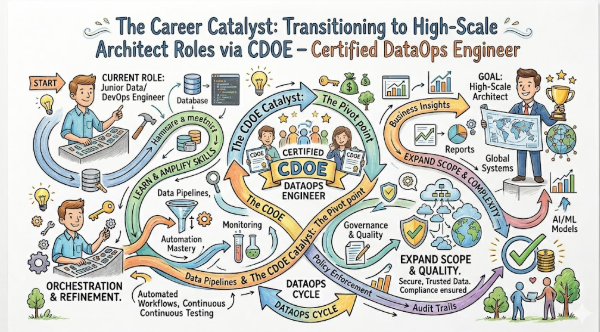
The modern enterprise data landscape is moving away from static pipelines toward agile, automated, and highly reliable data infrastructure. This comprehensive guide is designed for software engineers, DevOps practitioners, and data professionals who want to bridge the gap between data engineering and operational excellence. By focusing on continuous integration, automated testing, and robust monitoring for data workflows, this program establishes a clear framework for reducing deployment lifecycles and eliminating data downtime. Navigating this career path requires a strategic understanding of how data pipelines function as production-grade software, making a structured validation of these skills highly essential for long-term professional growth. Professionals can explore the complete curriculum and educational ecosystem directly through the official CDOE – Certified DataOps Engineer program hosted by DataOpsSchool.
What is the CDOE – Certified DataOps Engineer?
The CDOE – Certified DataOps Engineer designation is an industry-recognized professional credential designed to validate expertise in automating, orchestrating, and monitoring complex data workflows. Unlike traditional certifications that focus heavily on localized database administration or isolated data science scripts, this framework treats data delivery as an enterprise-grade engineering discipline. It addresses the critical challenges of data quality, pipeline scalability, and infrastructure automation by applying DevOps principles directly to data systems. Engineers holding this certification demonstrate that they can minimize data delivery cycle times while maintaining strict governance and system reliability.
Modern enterprises require data ecosystems that are resilient to schema changes, fluctuating data volumes, and multi-cloud infrastructure complexities. The curriculum emphasizes practical execution, ensuring that candidates master the tools and methodologies needed to build self-healing data pipelines and automated testing suites. By establishing rigorous standards for continuous integration and continuous deployment in data environments, it bridges the historical gap between software operations and analytical data processing.
Who Should Pursue CDOE – Certified DataOps Engineer?
This credential is engineered specifically for professionals operating at the intersection of infrastructure, software engineering, and data analytics. Cloud architects, DevOps engineers, and Site Reliability Engineers will find it highly valuable for expanding their operational domain into modern data platform engineering. Data engineers, database administrators, and business intelligence developers can leverage this path to transition from manual pipeline management to fully automated, code-driven infrastructure architectures.
Furthermore, engineering managers, technical leads, and enterprise solutions architects need this foundational knowledge to guide organizational data strategy and build high-performing engineering teams. The principles taught within the program apply universally across global tech hubs and rapidly expanding digital enterprise sectors in India. Whether you are an individual contributor looking to master production-grade data orchestration or a technology leader driving a corporate data transformation strategy, this certification path provides a structured, clear roadmap.
Why CDOE—Certified DataOps Engineer—is Valuable Beyond Tooling
Technology stacks change rapidly, but the core engineering methodologies governing data reliability and pipeline automation remain consistent over time. Relying solely on specific tool knowledge can limit career longevity as legacy platforms evolve or get replaced by cloud-native alternatives. This certification provides a deep understanding of architectural principles, enabling professionals to remain highly adaptable regardless of the underlying enterprise toolset.
As organizations scale their artificial intelligence, machine learning, and real-time analytics initiatives, the demand for stable, predictable data infrastructure grows exponentially. Possessing a validated understanding of automated testing, data quality monitoring, and environment provisioning makes professionals indispensable assets to hiring managers. The return on investment manifests as accelerated career progression, higher technical authority within engineering teams, and the capability to systematically eliminate costly data downtime within enterprise environments.
CDOE – Certified DataOps Engineer Certification Overview
The professional training framework is engineered to systematically validate a candidate’s practical capabilities across multiple operational dimensions. The program is structured into clear tiers that accommodate professionals entering from diverse technical backgrounds, ranging from infrastructure automation to data analytics. Assessment methodologies prioritize practical engineering scenarios, testing how effectively candidates can design, monitor, and troubleshoot production environments.
Ownership and administration of the program ensure that the educational content stays tightly aligned with evolving open-source tools and enterprise cloud architectures. Candidates engage with comprehensive study materials, laboratory environments, and architecture design challenges to ensure full operational readiness. The structural layout ensures that individuals do not merely memorize concepts but instead build a reproducible, production-ready skill set.
CDOE – Certified DataOps Engineer Certification Tracks & Levels
The certification structure follows a progressive hierarchy designed to guide engineers from fundamental automation concepts to advanced enterprise architecture management. The initial tier focuses heavily on core automation patterns, version control for data assets, and basic containerization strategies. This ensures that all candidates establish a standard baseline of operational literacy before advancing to complex multi-tier pipelines.
The professional and advanced tiers delve deeply into distributed system orchestration, end-to-end data quality frameworks, and proactive observability infrastructure. Specialized tracks allow professionals to align their studies with their specific operational focus areas, such as cloud infrastructure, financial governance, or machine learning pipelines. By progressing systematically through these levels, engineers can successfully match their educational milestones directly with real-world promotions and expanding technical responsibilities.
Complete CDOE – Certified DataOps Engineer Certification Table
| Track | Level | Who it’s for | Prerequisites | Skills Covered | Recommended Order |
| Data Operations | Foundation | Junior Engineers, Systems Analysts | Basic Linux, Python, SQL | Git, Docker, CI/CD Basics, Pipeline Concepts | 1st |
| Architecture & Automation | Professional | DevOps Engineers, Data Engineers | Foundation Level, Cloud Basics | Airflow, dbt, Automated Testing, Terraform | 2nd |
| Enterprise Infrastructure | Advanced | Principal Engineers, Architects | Professional Level, Advanced K8s | Kubernetes, Data Mesh, FinOps, Observability | 3rd |
Detailed Guide for Each CDOE – Certified DataOps Engineer Certification
CDOE – Certified DataOps Engineer – Foundation
What it is
This level validates a candidate’s fundamental understanding of applying DevOps practices to data lifecycles, ensuring a solid baseline of version control and automation literacy.
Who should take it
This entry-level program is ideal for junior data engineers, system analysts, and traditional database administrators seeking a structured transition into automated data workflows.
Skills you’ll gain
- Implementation of version control workflows for SQL and data transformation scripts.
- Building and deploying basic containerized environments using Docker.
- Configuring continuous integration pipelines for basic syntax and schema validation.
- Understanding core data orchestration and scheduling methodologies.
Real-world projects you should be able to do
- Construct a version-controlled repository that automatically builds a containerized data environment upon code changes.
- Design a localized data ingestion pipeline that validates incoming file formats before loading them into a target database.
Preparation plan
- 7–14 days: Review core Git workflows, Docker fundamentals, and standard data architecture terminology. Master basic command-line utilities.
- 30 days: Execute guided laboratory exercises focused on writing container files and configuring automated local build scripts.
- 60 days: Build multiple end-to-end local pipelines independently and complete comprehensive mock assessments to verify concept retention.
Common mistakes
- Underestimating the importance of foundational Git branch management strategies.
- Overcomplicating early infrastructure designs instead of focusing on clean, reproducible container configurations.
Best next certification after this
- Same-track option: CDOE – Certified DataOps Engineer – Professional
- Cross-track option: Cloud Infrastructure Associate
- Leadership option: Technical Team Lead Foundation
CDOE – Certified DataOps Engineer – Professional
What it is
This level verifies an engineer’s capability to architect, automate, and manage production-grade data pipelines using advanced orchestration and transformation frameworks.
Who should take it
Designed for mid-level DevOps engineers, systems administrators, and data engineers with at least two years of hands-on experience handling enterprise data infrastructure.
Skills you’ll gain
- Designing resilient DAGs using advanced orchestration platforms like Apache Airflow.
- Implementing automated data quality testing and transformation layers using dbt.
- Provisioning reproducible cloud data infrastructure utilizing infrastructure-as-code tools.
- Configuring centralized logging and alerting mechanisms for distributed data pipelines.
Real-world projects you should be able to do
- Build a production-ready cloud pipeline that automatically provisions infrastructure, triggers transformations, and validates data quality.
- Deploy a centralized monitoring system that sends immediate notifications to engineering teams upon pipeline step failures.
Preparation plan
- 7–14 days: Focus deeply on advanced Python scripting, infrastructure-as-code syntax, and distributed system concepts.
- 30 days: Build multi-stage orchestration workflows that interact directly with cloud-native data warehouses and storage buckets.
- 60 days: Implement rigorous error-handling, retry mechanisms, and schema evolution rules inside complex deployment projects.
Common mistakes
- Ignoring data quality checks within the pipeline, focusing solely on data movement.
- Hardcoding environmental configurations instead of utilizing secure environment variables and secret managers.
Best next certification after this
- Same-track option: CDOE – Certified DataOps Engineer – Advanced
- Cross-track option: Enterprise Kubernetes Administrator
- Leadership option: Data Operations Manager
CDOE – Certified DataOps Engineer – Advanced
What it is
This certification validates expert-level mastery in designing scalable, secure, and cost-optimized enterprise data platform architectures across multi-cloud environments.
Who should take it
Targeted at senior engineers, principal architects, and platform engineering leads responsible for designing large-scale distributed infrastructure systems.
Skills you’ll gain
- Designing scalable data architectures on top of enterprise Kubernetes clusters.
- Implementing zero-trust security and granular access control across distributed data meshes.
- Architecting advanced data observability frameworks for proactive performance tuning.
- Executing cost optimization strategies for large-scale storage and computing resources.
Real-world projects you should be able to do
- Architect an enterprise-wide data platform on Kubernetes that scales dynamically based on real-time computational workloads.
- Implement a comprehensive data lineage and observability dashboard tracking performance across multiple business units.
Preparation plan
- 7–14 days: Analyze advanced Kubernetes patterns, security compliance standards, and cloud cost allocation methodologies.
- 30 days: Design and deploy multi-cluster infrastructure blueprints incorporating advanced network policies and access controls.
- 60 days: Conduct deep architectural reviews of complex enterprise scenarios, optimizing them for maximum reliability and minimum cost.
Common mistakes
- Designing overly complex architectures that increase operational overhead without delivering clear business value.
- Overlooking security, data masking, and regulatory compliance rules during early platform design phases.
Best next certification after this
- Same-track option: Enterprise Data Platform Architect
- Cross-track option: Multi-Cloud Security Expert
- Leadership option: Chief Technology Officer / Director of Infrastructure
Choose Your Learning Path
DevOps Path
Engineers entering from a traditional DevOps background should focus heavily on understanding the unique characteristics of data workloads, such as statefulness, schema drift, and data volume variability. The learning path prioritizes translating existing infrastructure automation skills into managing data warehouses, query engines, and transformation tools. Professionals will learn how to wrap standard continuous integration loops around complex data manipulation scripts to treat data layers exactly like application source code.
DevSecOps Path
Security-focused professionals must understand how to integrate governance, data encryption, and access controls into automated data pipelines without introducing operational bottlenecks. This path emphasizes data-at-rest and data-in-transit encryption, dynamic identity management, and automated compliance auditing within the analytics layer. Candidates will master techniques for automatically scanning data structures for sensitive information, ensuring strict adherence to regulatory compliance parameters globally.
SRE Path
Site Reliability Engineers pursuing this discipline will concentrate on establishing service level indicators and objectives specifically tailored to data quality and availability. The educational focus centers on building deep platform observability, defining clear alert thresholds for data freshness, and designing self-healing, fault-tolerant ingestion pipelines. Practitioners learn how to systematically handle distributed systems failures, manage resource saturation in compute clusters, and run blameless post-mortems on data outages.
AIOps Path
Professionals focusing on specialized operations learn to automate the continuous deployment pipelines required for predictive anomaly detection and system telemetry analysis. This path teaches engineers how to manage large volumes of operational infrastructure logs, trace application metrics, and automate root-cause analysis pipelines. Candidates master the infrastructure patterns necessary to process massive volumes of system performance data rapidly, allowing operations teams to predict outages before they occur.
MLOps Path
This learning track focuses directly on the operationalization of machine learning models, managing the entire lifecycle from feature store engineering to model deployment. Engineers learn how to establish automated validation steps for training data, track model lineage, and monitor production inference endpoints for data drift. The curriculum bridges the gap between data science experimentation and production-grade software deployments, ensuring models remain accurate and reliable over time.
DataOps Path
Dedicated data professionals utilize this specific path to move past legacy manual database administration and ad-hoc script management techniques. The training highlights the application of agile software methodologies, automated testing frameworks, and version control systems to large-scale data warehouses and lakes. Engineers graduate with the capacity to reduce analytical project cycle times significantly while establishing repeatable, documented data delivery mechanisms.
FinOps Path
Financial engineering specialists focus on tracking, allocating, and optimizing the cloud expenditure associated with modern, massive-scale data processing platforms. This path delivers deep insights into computing resource utilization, storage lifecycle policies, and modern multi-tenant cost allocation methodologies. Professionals master the design of automated alerting thresholds that prevent runaway cloud compute costs during heavy, unexpected analytical query loads.
Role → Recommended CDOE – Certified DataOps Engineer Certifications
| Role | Recommended Certifications |
| DevOps Engineer | CDOE Professional, Enterprise Kubernetes Administrator |
| SRE | CDOE Professional, SRE Site Reliability Practitioner |
| Platform Engineer | CDOE Advanced, Cloud Infrastructure Architect |
| Cloud Engineer | CDOE Foundation, Cloud Infrastructure Associate |
| Security Engineer | CDOE Professional, DevSecOps Security Specialist |
| Data Engineer | CDOE Foundation, CDOE Professional |
| FinOps Practitioner | CDOE Professional, Cloud Cost Optimization Specialist |
| Engineering Manager | CDOE Foundation, Technology Management Professional |
Next Certifications to Take After CDOE – Certified DataOps Engineer
Same Track Progression
Upon mastering the core operational capabilities, engineers should aim for deeper technical specialization within distributed processing landscapes. This involves pursuing advanced certifications focused on massive-scale data real-time processing frameworks, advanced streaming architectures, and complex multi-region storage replication strategies. Continuous education in these areas ensures that engineers can efficiently lead large-scale architectural migrations without impacting day-to-day enterprise operations.
Cross-Track Expansion
Broadening your technical footprint requires acquiring validated skills in adjacent domains such as advanced cloud security, container orchestration at scale, and systems observability. Pursuing specialized infrastructure credentials complements your existing data operations capabilities, transforming you into a highly versatile platform engineer. This cross-functional knowledge allows professionals to collaborate seamlessly with infrastructure teams and secure enterprise environments holistically.
Leadership & Management Track
Transitioning into engineering leadership demands a shift from hands-on technical execution to strategic resource allocation, team scaling, and budget management. Professionals should look toward technology management and enterprise architecture certifications that emphasize agile product delivery methodologies and financial optimization. This ensures that you can align technical engineering capabilities closely with overall business objectives and corporate growth strategies.
Training & Certification Support Providers for CDOE – Certified DataOps Engineer
DevOpsSchool delivers highly immersive, instructor-led training programs that focus on core infrastructure automation, continuous integration, and comprehensive cloud-native delivery workflows. Their training methodologies prioritize interactive laboratories and real-world infrastructure scenarios, preparing engineers for complex operational deployment challenges across enterprise systems.
Cotocus specializes in providing customized corporate training solutions focused on modern software delivery acceleration, containerization strategies, and advanced platform engineering methodologies. Their programs are designed to align engineering teams with modern, highly efficient production practices.
Scmgalaxy offers an extensive repository of educational resources, community forums, and structured tutorials covering configuration management, build automation, and version control best practices. It serves as a valuable knowledge hub for engineers seeking to refine their operational automation skills.
BestDevOps provides focused career bootcamps and practical training paths designed to help technology professionals rapidly transition into high-demand cloud and infrastructure automation roles. Their content centers on production-ready patterns and toolsets.
devsecopsschool emphasizes the critical integration of automated security protocols, vulnerability scanning, and compliance tracking directly into modern software deployment pipelines. Their courses teach engineers how to secure infrastructure from inception to production.
sreschool focuses on educating engineers in the core disciplines of systems reliability, proactive monitoring architecture, incident management, and modern blameless engineering culture. Their curriculum helps teams design self-healing architectures that minimize enterprise system downtime.
aiopsschool provides advanced training centered on leveraging artificial intelligence and machine learning models to analyze enterprise telemetry, automate incident response, and optimize system monitoring. Their courses prepare engineers for the future of automated operations.
dataopsschool stands as the definitive educational source for specializing in automated data delivery, pipeline orchestration, data quality testing, and scalable data infrastructure engineering. Their programs provide the primary baseline for modern data operations mastery.
finopsschool delivers specialized education focused on cloud financial management, cloud resource cost allocation frameworks, and continuous infrastructure spend optimization methodologies. Their training helps organizations maintain complete financial visibility over complex cloud architectures.
Frequently Asked Questions (General)
- What is the primary focus of data operations engineering certifications? The main focus is validating an engineer’s capability to apply continuous integration, automated testing, and agile operational practices directly to enterprise data pipelines and analytics infrastructure.
- How do these certifications differ from standard software engineering credentials? They focus specifically on handling the unique challenges of data systems, including stateful operations, schema evolution management, data quality verification, and massive distributed compute resource orchestration.
- Are there entry-level options available for absolute beginners? Yes, the foundational levels are designed specifically to accommodate junior engineers, traditional database administrators, and systems analysts transitioning into automated data workflows.
- What baseline technical skills are required before beginning? Candidates should ideally possess a fundamental understanding of command-line Linux utilities, basic Python scripting, relational database concepts, and basic Git version control workflows.
- How long does it typically take to prepare for a professional-level exam? Most mid-level professionals with existing infrastructure or data experience spend between 30 to 60 days completing practical laboratories and studying architectural design principles.
- Do these certifications mandate hands-on practical engineering assessments? Yes, advanced industry programs focus heavily on verifying real-world implementation capabilities through practical laboratory environments rather than relying purely on theoretical multiple-choice formats.
- How do these credentials impact long-term career advancement? They establish clear validation of highly specialized skills, positioning professionals for advanced roles such as senior platform engineer, data architect, or infrastructure technical lead.
- Can an application engineer easily transition into this operational path? Absolutely, application engineers can leverage their existing programming skills and version control knowledge while focusing on mastering distributed data storage and orchestration systems.
- Are these programs relevant for multi-cloud enterprise architectures? Yes, the underlying architectural patterns, automation principles, and data quality frameworks taught are completely cloud-agnostic and apply universally across major cloud providers.
- How often should these professional credentials be renewed? Most advanced technology certifications require recertification every two to three years to ensure the professional’s skills remain aligned with evolving industry tools and practices.
- What strategy avoids common mistakes during preparation? The most effective strategy is spending significant time building independent projects in local sandbox environments, rather than simply reading documentation or memorizing theoretical terms.
- Do engineering managers benefit from pursuing these paths? Yes, understanding these technical concepts allows managers to accurately estimate project timelines, build high-performing engineering teams, and execute viable corporate data strategies.
FAQs on CDOE – Certified DataOps Engineer
- What specific value does the CDOE – Certified DataOps Engineer credential offer to modern data teams? It provides a verified standard for automating data delivery, establishing that an engineer can eliminate manual deployment mistakes, reduce data pipeline downtime, and ensure consistent data quality across the entire enterprise analytics ecosystem.
- Is the CDOE – Certified DataOps Engineer examination entirely theoretical or does it require laboratory work? The assessment methodology prioritizes real-world technical execution, testing candidates on their practical capacity to troubleshoot broken pipelines, configure infrastructure-as-code, and deploy operational monitoring tools in production-simulated environments.
- Can I skip the foundation level and take the CDOE – Certified DataOps Engineer Professional exam directly? While experienced DevOps or data engineers can theoretically skip the introductory exam, completing the foundation tier ensures a complete alignment with specific terminology and baseline architectural automation frameworks used in advanced modules.
- How does the CDOE – Certified DataOps Engineer curriculum handle data governance and information security? Security is treated as a fundamental pillar throughout the certification track, teaching engineers how to embed automated compliance checks, granular encryption protocols, and role-based access controls directly into automated pipelines.
- Which specific pipeline orchestration platforms are emphasized within the CDOE – Certified DataOps Engineer labs? The training focuses on mainstream, production-proven open-source and cloud-native toolsets such as Apache Airflow, dbt, Kubernetes, and Terraform, ensuring skills are immediately applicable to standard corporate infrastructures.
- How does holding the CDOE – Certified DataOps Engineer certification improve an engineer’s marketability in India? As enterprise organizations rapidly expand their data footprints, the market highly values professionals who can control cloud infrastructure costs and build resilient data systems, resulting in significant demand across major domestic technology sectors.
- What is the recommended daily study commitment for passing the CDOE – Certified DataOps Engineer Advanced level? Candidates aiming for the advanced tier should dedicate approximately one to two hours daily over a 60-day window, focusing heavily on complex multi-cluster configuration labs and advanced systemic observability.
- Does the CDOE – Certified DataOps Engineer program cover financial cost optimization for large data warehouses? Yes, cost visibility and compute resource optimization are core components, ensuring that certified engineers know how to build highly efficient pipelines that prevent unexpected cloud expenditure during heavy processing.
Final Thoughts: Is CDOE – Certified DataOps Engineer Worth It?
Investing time and professional energy into acquiring a specialized technical credential is a decision that should be guided by long-term industry trends and personal career objectives. The transition from legacy, manual data management toward fully automated, programmable data infrastructure is not a temporary trend; it represents a permanent evolution in enterprise software architecture. Organizations across the globe require technical professionals who can ensure the reliability, security, and financial efficiency of their critical data flows.
The CDOE – Certified DataOps Engineer program offers a clear, highly structured, and fluff-free pathway to acquiring those exact capabilities. It avoids temporary tool hype and instead focuses heavily on establishing sustainable engineering patterns that remain valuable over time. If your objective is to move away from reactive troubleshooting and instead build resilient, automated data platforms that drive clear corporate value, pursuing this certification path is a highly practical investment in your professional future.

